

For most of the last two years, the story of enterprise AI has been a story of stalled pilots — impressive demos that never survived contact with a security review, a compliance question, or a production incident. The prototypes were never the problem. The path to production was.
What changed in 2026 is that governance and security tooling saw the biggest usage uptick across the AI stack, and it’s no coincidence that organisations with strong governance get many times more AI projects into production. Governance isn’t a brake on delivery — it’s the guardrail system that lets teams move fast without fear.
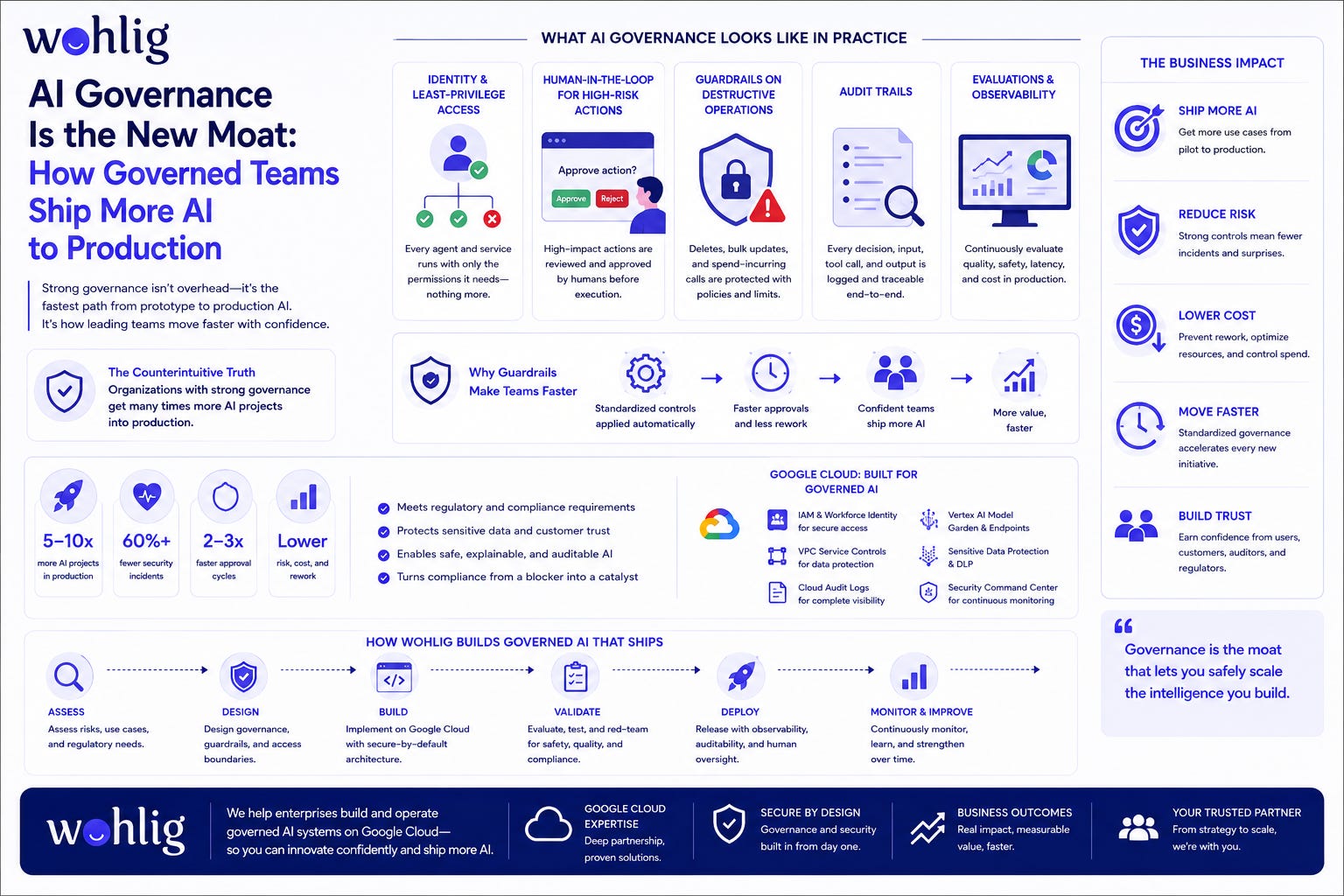
The counterintuitive truth: governance ships more AI
Leading teams stopped treating governance as the thing you bolt on after the model works. They treat it as the thing that makes shipping possible at all. When every AI action is identity-aware, auditable and bounded by clear guardrails, the risk conversation moves from “should we allow this” to “here’s exactly what it can and cannot do.” That shift is what unblocks approvals. Governed teams don’t ask for permission to experiment — they’ve already answered the questions that used to freeze a project for months.
The moat isn’t the model. Frontier models are increasingly a commodity available to everyone. The durable advantage belongs to the organisations that can safely put those models to work on real data, in real workflows, at scale. Governance is what turns a capable model into a trustworthy system, and trust is what production requires.
What governance actually looks like in practice
Governance is often discussed as an abstraction. In a working AI platform it’s a set of concrete, engineered controls.
Identity and least-privilege access. Every agent, service and workflow runs as a known identity with the narrowest permissions it needs, and nothing more. An AI assistant that reads support tickets shouldn’t hold the credentials to modify billing records. Scoping access by identity is the single most effective way to contain the blast radius of a mistake or a compromised prompt.
Human-in-the-loop for high-risk actions. Not every action should be autonomous. Governance defines which operations require a human to review and approve before execution: issuing a refund, sending an external communication, changing a production configuration. The system proposes, a person disposes, and the boundary between the two is explicit rather than accidental.
Guardrails on destructive operations. Certain actions are irreversible or costly, and a governed system treats them differently. Deletes, bulk updates and spend-incurring calls sit behind policy checks, rate limits and confirmation steps. The goal isn’t to prevent the AI from acting, but to ensure it can’t act catastrophically.
Audit trails. Every decision, input, tool call and output is logged in a way that can be reconstructed later. When a regulator, an auditor or an incident reviewer asks what happened and why, a governed system can answer with evidence rather than speculation.
Evaluations and observability. Governance extends to quality. Systematic evaluations measure whether an AI system is accurate, safe and on-task before and after it ships. Observability then tracks quality, latency and cost in production, so degradation is caught early rather than discovered through a customer complaint.
Each of these controls does double duty. It reduces risk, and it produces the evidence that shortens every future approval.
Why guardrails make teams faster, not slower
The intuition that governance slows delivery comes from a world where controls were manual, inconsistent and applied late. In that world, governance really was friction: a spreadsheet of open questions, a security review that started from zero every time, a compliance sign-off no one could predict.
Engineered governance inverts that. When least-privilege access, human-in-the-loop checkpoints and audit logging are built into the platform, they apply automatically to every new use case. A team launching its fifth AI workflow inherits the controls that were proven on the first four. The approval that took three months for the pilot takes days for the next project, because the hard questions have standard answers.
This is the same lesson the industry learned with continuous integration and automated testing. Teams that invested in the harness shipped more, not less, because they could change things confidently. Governance is that harness for AI. It converts one-off anxiety into repeatable process, and repeatable process is what lets an organisation say yes to the next idea instead of stalling on it.
Governance is non-negotiable in regulated industries
For enterprises in financial services, healthcare, insurance and the public sector, the case is even sharper. These organisations don’t have the option of shipping AI they can’t explain, audit or control. Data residency, access controls and record-keeping aren’t preferences — they’re legal obligations.
For these teams, governance is the difference between an AI program that reaches production and one that never leaves the lab. The controls that skeptics see as overhead are precisely what allow a bank or a hospital to deploy AI at all. Built well, governance doesn’t just satisfy the auditor. It gives the business the confidence to use AI where it matters most — on the sensitive workflows that create the most value.
How Wohlig helps
Wohlig Transformations is a Google Cloud transformation and AI partner. We build cloud platforms, agentic AI, data and BI systems, and internal developer platforms for enterprises on GCP — and we build them to be governed from day one.
That means identity-aware, least-privilege access for every agent and service, human-in-the-loop approval for high-risk actions, guardrails around destructive and costly operations, complete audit trails, structured evaluations, and production observability of AI quality and cost. We design these controls as part of the platform, not as an afterthought, so your teams inherit governance automatically and ship faster with each new use case.
If you want to move from stalled pilots to AI that runs confidently in production — especially in a regulated environment — we’d like to help. Talk to Wohlig about building governed AI on Google Cloud, and turn governance into your durable advantage.