

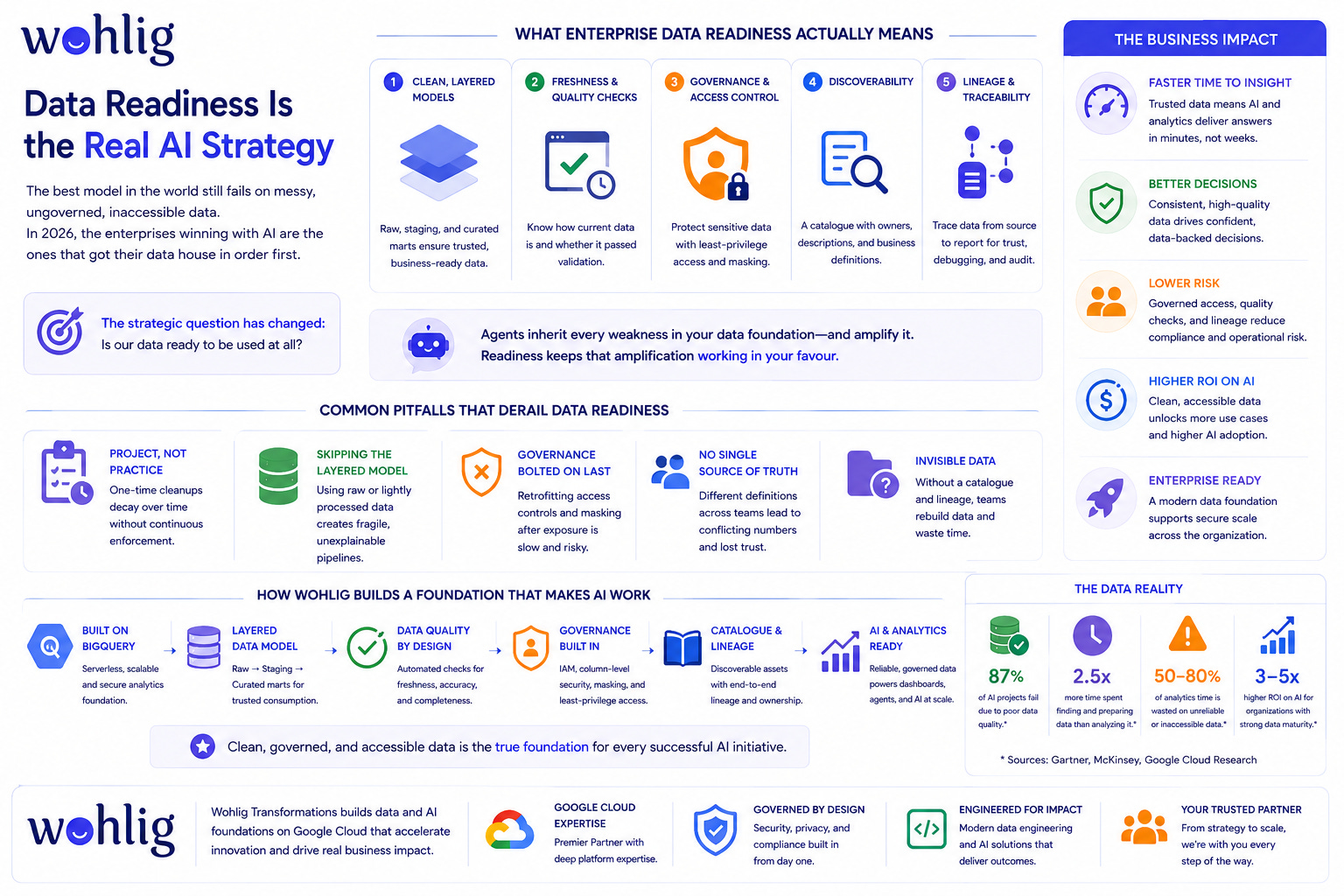
Most enterprise AI initiatives don’t fail because the model was too weak. They fail because the data feeding the model was never ready. A frontier model can reason brilliantly and still produce confident nonsense when the underlying tables are stale, duplicated, undocumented, or scattered across systems no one fully trusts.
This is why the conversation has shifted. Through 2026, Google Cloud and other industry leaders have consistently named data readiness and orchestration — not model choice — as the real competitive differentiator in enterprise AI. Models are increasingly commoditised and interchangeable. Your data estate is not. It’s the one asset your competitors can’t copy, and it’s also the one most likely to quietly sabotage your AI ambitions.
For CTOs and data leaders, the strategic question is no longer “which model should we use.” It’s “is our data ready to be used at all.”
What enterprise data readiness actually means
Data readiness isn’t a single dashboard or a one-time cleanup project. It’s a set of durable properties your data estate needs to hold, continuously, for AI and analytics to be trustworthy. Five of them matter most.
Clean, layered models. Raw data should never be consumed directly by analytics or agents. A disciplined warehouse separates concerns into layers: a raw zone that preserves source data exactly as it arrived, a staging zone where data is cleaned, typed and standardised, and a curated marts layer that exposes business-ready tables with clear definitions. Layering makes transformations transparent, testable and reproducible.
Freshness and quality checks. Ready data is data you can date. Every consumer should know how current a table is and whether it passed validation. Automated checks for nulls, duplicates, referential integrity and value ranges catch problems before they reach a model or an executive report.
Governance and access control. Readiness includes knowing who can see what. Sensitive fields need to be protected at a granular level, and access needs to follow the principle of least privilege rather than blanket table permissions.
Discoverability. If people can’t find a trusted dataset, they’ll rebuild it, badly. A catalogue with clear ownership, descriptions and business definitions turns a warehouse from a dumping ground into a usable product.
Lineage. When a number looks wrong, you need to trace it back to its source. Lineage that maps how data flows from ingestion through every transformation is what makes debugging, auditing and compliance possible.
Why readiness is the precondition for agents and analytics
Agentic AI raises the stakes on all of this. A dashboard shows a human a number, and a thoughtful analyst can sanity-check it. An agent acts. It queries your data, reasons over it, and takes steps: drafting responses, triggering workflows, updating records. If the data it reads is wrong or the access it holds is too broad, the mistake propagates at machine speed.
That means the qualities above stop being nice-to-haves. Freshness determines whether an agent is acting on today’s reality or last quarter’s. Quality checks determine whether it inherits your data errors as facts. Access control determines whether an agent can be trusted with a query at all, or whether it might surface data a user was never permitted to see. Lineage determines whether you can explain and defend what the agent did after the fact.
In short, agents inherit every weakness in your data foundation and amplify it. Readiness is what keeps that amplification working in your favour.
Common pitfalls that derail data readiness
A few patterns show up again and again in enterprises that struggle:
Treating readiness as a project, not a practice. Teams do a heroic cleanup, declare victory, and watch quality decay because nothing enforces it going forward.
Skipping the layered model. Pointing reports and agents straight at raw or lightly processed data feels faster but creates fragile, unexplainable pipelines.
Governance bolted on last. Retrofitting access control and column-level security after data is already widely exposed is far harder than designing it in from the start.
No single source of truth. When every team maintains its own definition of “active customer” or “revenue,” AI outputs become impossible to reconcile.
Invisible data. Without a catalogue and lineage, institutional knowledge lives in a few people’s heads, and every new use case starts from zero.
None of these are exotic. They’re the default state of a data estate that grew organically without a foundation designed for it.
How Wohlig builds a foundation that makes AI work
Wohlig Transformations is a Google Cloud transformation and AI partner. We treat data readiness as the groundwork for everything else we build — from agentic AI to analytics to internal developer platforms.
On Google Cloud, that foundation centers on BigQuery. We design a layered warehouse with a clear raw, staging and marts structure, so that source data is preserved, transformations are transparent, and business teams consume trusted, well-defined tables rather than raw feeds. We embed automated data quality checks into the pipeline so freshness and validation are continuous rather than occasional.
Governance is designed in from the beginning. We use IAM to enforce least-privilege access and column-level security to protect sensitive fields, so the right people and the right agents see only what they should. We build for discoverability and lineage, so datasets have clear owners and definitions and every number can be traced back to its source.
The result is a data estate where AI isn’t a gamble. When the foundation is clean, layered, governed and observable, agents and analytics have something solid to stand on, and the model finally becomes the easy part.
If your AI roadmap is outpacing your data foundation, that gap is where projects quietly stall. Talk to Wohlig about assessing your enterprise data readiness and building the foundation your AI strategy actually depends on.