

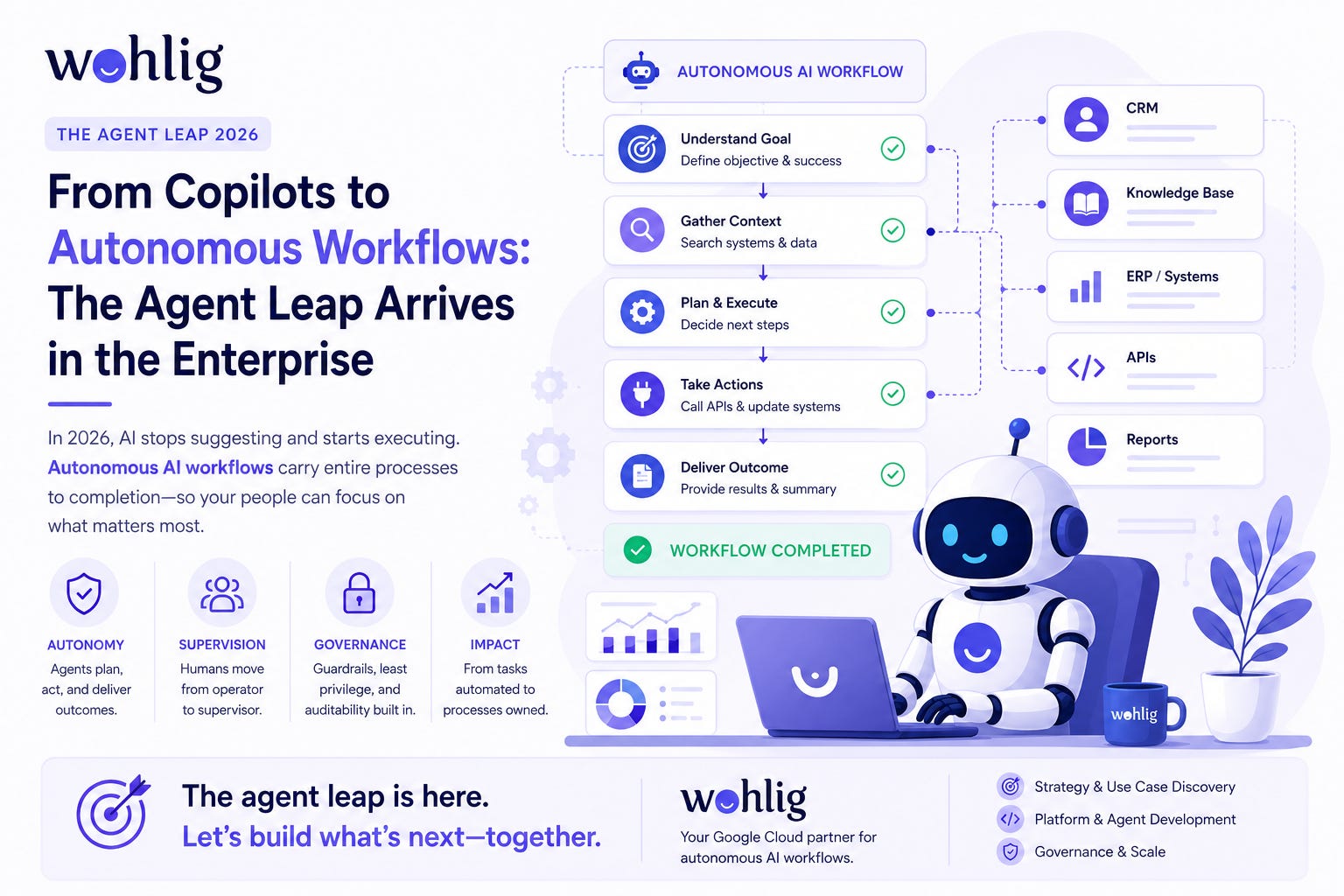
For the past few years, AI at work has mostly meant a copilot sitting beside a person: it drafts an email, suggests a code change, summarises a ticket, and waits for a human to accept or reject. The human is still the engine of the workflow. The AI is a very capable passenger.
In 2026, that relationship is inverting. Enterprise AI is crossing what Google Cloud calls the agent leap — the shift from copilots that suggest next steps to agents that carry entire workflows to completion with light human oversight. The opportunity is real, but so is the operational risk. The teams that win start with bounded, high-volume processes, wrap their agents in strong governance, and build on a platform designed for autonomy from day one.
What actually changes at the agent leap
Autonomous AI workflows invert the copilot relationship. Instead of suggesting a single next step, an agent is given a goal, a set of tools, and a boundary — and it plans and executes the steps needed to reach an outcome. It can call APIs, query systems of record, chain multiple actions together, react to what it finds, and hand back a finished result rather than a suggestion. The human moves from operator to supervisor, reviewing outcomes and handling the exceptions the agent escalates.
That’s the leap. It matters because the value of AI stops being measured in keystrokes saved and starts being measured in whole processes owned. A copilot makes one person faster. An agentic workflow can absorb the routine 80 percent of a process, so your people spend their time on the judgement-heavy remainder.
Where the real value shows up
The change is most visible in workflows that are repetitive, rule-heavy, and spread across multiple systems. A few patterns recur across enterprises:
Customer operations, where an agent triages an incoming request, gathers context from your CRM and knowledge base, drafts a resolution, and escalates only the genuinely ambiguous cases.
Data and reporting, where an agent pulls from multiple sources, reconciles the numbers, and assembles a draft report that an analyst reviews rather than builds from scratch.
Engineering and platform tasks, where an agent handles routine provisioning, dependency updates, or first-pass diagnostics inside guardrails set by the team.
Back-office processing, such as invoice matching, document intake, and compliance checks that today consume large amounts of manual effort.
The common thread isn’t glamour. It’s volume and structure. The best first candidates are processes your team already understands well enough to describe as a set of steps — with clear inputs, clear success criteria, and a tolerance for the occasional handoff to a human.
What to automate first
Choosing the first workflow is where most programs succeed or stall. A practical filter has four parts.
First, pick something with high frequency and clear economics, so the effort pays back quickly and gives you a real signal. Second, favour workflows with well-defined boundaries, where you can state precisely what the agent may and may not touch. Third, make sure a ground truth exists, so you can measure whether the agent’s output is correct rather than merely plausible. Fourth, keep a human in the loop at the start, reviewing outcomes before they take effect, and widen the agent’s autonomy only as its track record earns it.
Resist the temptation to begin with your most complex, highest-stakes process. Start where a mistake is recoverable, prove the pattern, and expand from a position of evidence.
The risks you have to design for
Autonomy raises the stakes, because an agent that takes actions can also take wrong actions at scale. The failure modes are different from those of a copilot, and they deserve deliberate design.
The first is unbounded action. An agent with broad permissions and a vague goal can do more damage faster than any single person. The answer is least-privilege access, scoped tools, and hard limits on what any workflow can reach.
The second is silent error. Because the human is no longer watching every step, mistakes can accumulate unseen. This is why observability isn’t optional: every decision, tool call, and output should be logged and traceable, so you can audit what happened and why.
The third is drift and ambiguity. Real workflows contain edge cases, and an agent that improvises when it should escalate is a liability. Clear escalation paths, confidence thresholds, and human review for consequential decisions keep autonomy accountable.
The fourth is governance and data protection. Agents touch sensitive systems and data, so identity, access control, and compliance need to be built into the platform rather than bolted on afterward. Treat an agent as a first-class actor in your security model, not an exception to it.
Handled well, these aren’t reasons to wait. They’re the design requirements that separate a pilot that survives contact with production from one that doesn’t.
How Wohlig helps
Wohlig Transformations is a Google Cloud transformation and AI partner that designs and ships autonomous AI workflows built for the enterprise. We help you identify the right first workflows, ground your agents in your own data through robust data and BI foundations, and build on Google Cloud with security, observability and governance designed in from the start. Because we also build cloud platforms and internal developer platforms, the agents we ship land on infrastructure your teams can operate and trust.
If your organisation is ready to move from copilots that suggest to workflows that execute, talk to Wohlig. We’ll help you pick a first workflow, prove the value, and scale autonomy safely on Google Cloud.