

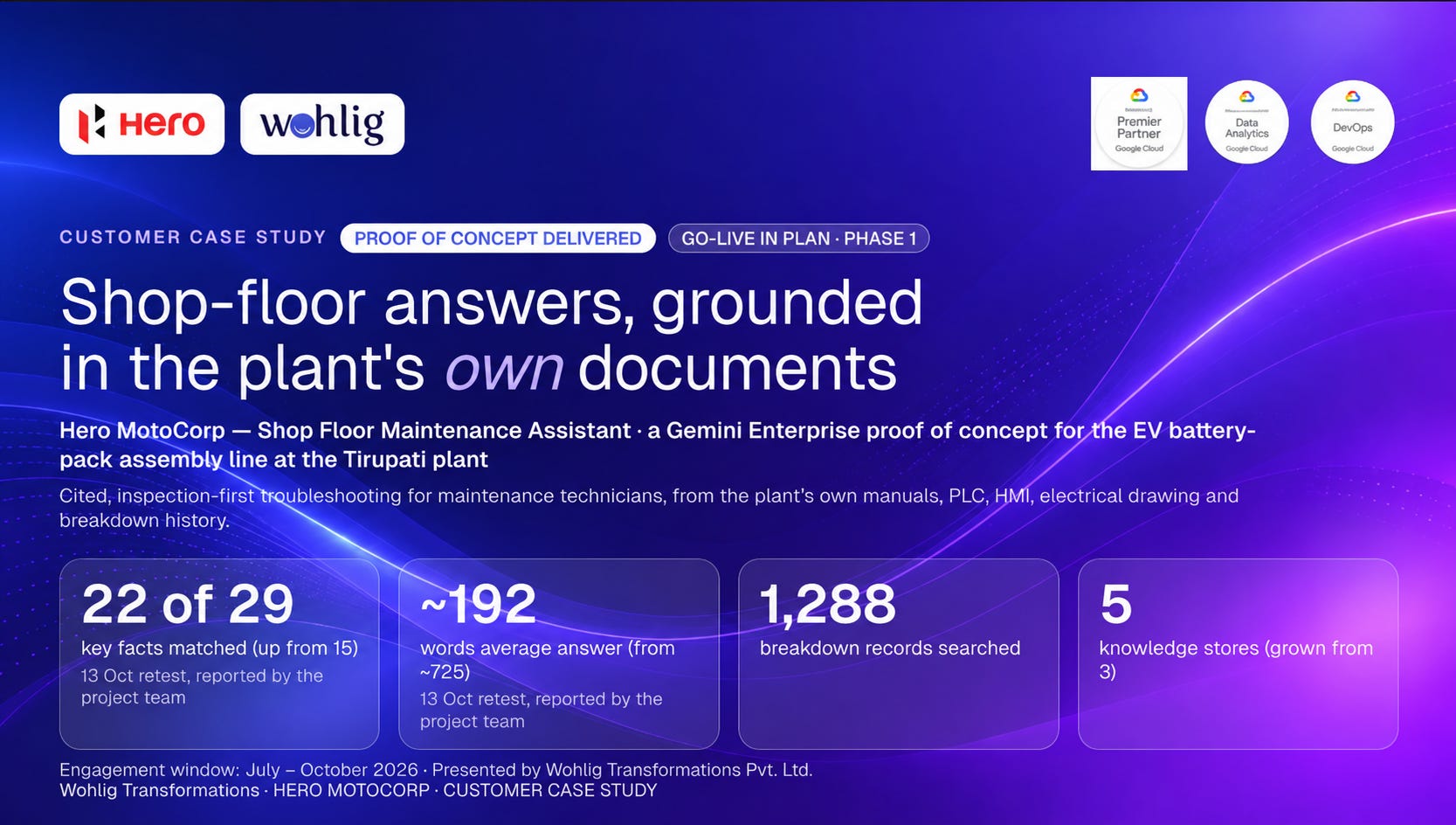
Hero MotoCorp partnered with Wohlig Transformations to build a proof of concept for a Shop Floor Maintenance Assistant on Gemini Enterprise — a no-code agent, running in Hero MotoCorp’s own Google Cloud project, that gives maintenance technicians on the EV battery-pack assembly line at its Tirupati plant cited, inspection-first troubleshooting in Hindi and English, drawn only from the plant’s own manuals, PLC and HMI exports, electrical drawing and a 1,288-record breakdown register. In a 13 October retest, reported by the project team, the agent matched 22 of 29 key facts on 11 fault logs from the first zone (up from 15) while average answer length fell from about 725 to about 192 words.
Project Overview
Maintenance technicians on the battery-pack assembly (BPA) line at Hero MotoCorp’s Tirupati plant (Andhra Pradesh) need the right next step within minutes of a breakdown, in their own language, without searching through manuals, PLC programs and breakdown registers. The line runs 24×7 across 152 production assets, so a technician on the night shift may have no senior engineer beside them. Hero MotoCorp and Wohlig set out to put one cited first answer in every technician’s hands.
Over July to October 2026, Wohlig built the Shop Floor Maintenance Assistant (known at Hero MotoCorp as the EV Maintenance Chatbot) as a no-code Gemini Enterprise agent inside Hero MotoCorp’s own Google Cloud project. It is a proof of concept: it has been delivered and tested by Hero MotoCorp’s maintenance team on the first-zone line, but it is not yet signed off and not yet live. Go-live is in plan as Phase 1 of a two-phase production plan. The scope was deliberately narrow: one agent, one line, Hero MotoCorp’s own documents, inside Hero MotoCorp’s own Google Cloud tenant. Sensor-based predictive maintenance is a separate project.
The Challenge
Help when it is needed. Less-experienced technicians on the night shift often work without senior support, so breakdowns wait or are mishandled.
Knowledge in formats nobody can search quickly. Per-station technical and maintenance manuals, zone control manuals, a PLC program of about 3,500 pages, an HMI project of about 8,400 pages, an electrical drawing and a breakdown register. The fix is often one cable, relay or sensor — but finding it means hunting across all of them.
Proprietary program files. The native PLC and HMI project files cannot be read by any Gemini Enterprise connector. They had to be exported and prepared before an assistant could use them.
Repeat breakdowns, many languages, shop-floor devices. Technicians speak Hindi, Telugu, Tamil and English, by text and voice, on tablets, and expect equipment tags and alarm codes to stay exactly as they are written on the machine.
Key Objectives
Cited, step-by-step troubleshooting: Answers from manuals, PLC, HMI, electrical drawing and breakdown history, each naming its source.
Inspection first: Simple physical checks before manual mode, which can disturb the automatic sequence.
Cable-level pointers: Name the exact wire, relay, module or hub, with the drawing page.
Why-Why and actions: Root cause (operational or engineering), corrective action and preventive action.
Multilingual, multimodal: Hindi and English by text and voice; photo and video of a fault.
Honest limits: Decline anything that needs live machine state, rather than guess.
The Solution: A Grounded, Read-Only Assistant Built Inside the Client’s Cloud
One agent, five knowledge stores. A single root agent on Gemini 3.8 Flash with Google Search grounding switched off, searching five Gemini Enterprise data stores in one blended search: manuals plus breakdown register (74 documents: 73 manuals and the register), first-zone PLC (3,463 pages in 12 parts), first-zone HMI (8,370 pages in 30 parts), the first-zone electrical drawing (333 sheets) and procedures (4 SOPs, a troubleshooting guide and sample report forms). The stores grew from 3 to 5 as gaps were found.
Documents prepared, not just uploaded. Source files go to a private Cloud Storage bucket and are imported once per content group, with layout-aware parsing for tables, headings and image captions. Each group can be re-imported without touching the others. The PLC and HMI exports were split into parts to fit ingestion limits.
Cable-level answers from a drawing a model cannot read. The electrical drawing is stored one page per document with a page index of sheet titles, wires, cable tags, devices and PLC addresses. The agent follows a chain: alarm, then PLC address, then drawing page, then the wire, relay, module or hub. Wire 03112, for example, resolves to the normally-closed contact of an emergency-stop pushbutton on page 67.
A short answer shaped by technicians. Up to five one-line “Check now” steps, likely cause, root cause type, preventive action and sources — about 200 words, no tables. Technicians reply MORE for detail or WHY-WHY for a five-step Why-Why chain.
Seven instruction versions. The agent’s behaviour is set by a plain-text instruction, rewritten and retested seven times between August and October. Version 3 made the electrical lookup mandatory, set the short format and made inspection-first a hard rule.
Capabilities. Twelve: alarm to action, error-code and tag lookup, cable-level lookup (first zone), breakdown history, Why-Why, corrective and preventive actions, citations, MORE follow-up, photo and video, Hindi and English text and voice, SOP retrieval and report-format drafting. The last two are in progress.
Read-only by design. No tools, no connection to machines, PLCs or work-order systems. It declines live PLC state, live interlock tracing, response-time guarantees and zero-breakdown guarantees, and says so plainly.
Hosting and access. Gemini Enterprise web app on tablets, with the Android app paired by QR code; outbound HTTPS only with no inbound firewall rules; Google Identity with named users proposed for production.
Evaluation assets prepared. 20 benchmark Q&A from Hero MotoCorp’s team, a 31-query evaluation battery, a 31-query manual test sheet for testers, 11 fault logs from the first zone with 29 key facts, a 16-question regression and a 17-item observations tracker.
Proposed next phases. Phase 1 (six workstreams): tuning and acceptance, content for other zones, named users, tablet validation, security and governance, rollout and hypercare. Phase 2 (seven stages, indicative 8 to 10 weeks): read-only live PLC reads through an operations-initiated, brokered, allowlisted path.
Key Benefits & Results
Previous: A technician searches manuals, PLC programs and registers by hand. Our Solution: One agent searching five stores, joined on equipment number and zone. Result: A cited first answer that brings breakdown history, manual, PLC and drawing together.
Previous: Alarm text alone did not reach the right cable or relay. Our Solution: A page-indexed electrical drawing and a mandatory lookup step. Result: In the 13 October retest, reported by the project team, key facts matched rose from 15 to 22 of 29, and the drawing page was cited in most answers (none before).
Previous: Answers averaged about 725 words, often with tables. Our Solution: A strict short format. Result: About 192 words on average, 1 of 28 answers with a table (reported by the project team).
Previous: Manual mode sometimes suggested first. Our Solution: An inspection-first hard rule. Result: Inspection before manual mode in 11 of 11 answers, up from 9 of 11 (reported by the project team).
Still short: 7 of 29 key facts, where the exact relay or module is not yet named. Refinements are drafted and a retest is pending. Time to repair and adoption have not been measured.
Language and channels: Hindi and English work by text and voice; Tamil and Telugu voice, and mobile-app behaviour for custom agents, are being validated.
Technical Innovation
Page-Level Index for a Schematic. One electrical drawing page per document, with a page index of wires, cable tags, devices and PLC addresses, so a tag or address query lands on the right sheet — plus tag-form normalisation (a spoken 052003 is tried as 052W03).
Grounding Over Helpfulness. The agent says “not documented” instead of inventing a step, labels inferences, and states when a zone has no drawing loaded.
Cross-Source Reasoning. Equipment number and zone join breakdown history, manuals, PLC logic and HMI screens, so one answer carries evidence from several sources.
One Store per Content Group. A re-import of one source cannot wipe another, so manuals, PLC, HMI, drawing and procedures refresh independently.
A Safe Design for Live Reads. The proposed Phase 2 path is read-only, starts from the plant side so nothing connects inbound, reads only allowlisted devices, ties each read to the technician, and has a kill switch — in a separate app so the document assistant is unaffected.
Wohlig’s Approach
Discover and scope — Use-case calls with the maintenance team; 11 functional requirements captured; feasibility stated up front.
Design — Hosting, network and access, data-flow and multimodal designs; a prototype to test document formats.
Build in the client’s project — Agent, five knowledge stores and instruction created in Hero MotoCorp’s own Google Cloud project.
Test on the shop floor — Hero MotoCorp’s engineers tested on the first-zone line with induced faults and real breakdowns; Wohlig re-ran a 16-question regression after every change.
Tune — Seven instruction versions; the electrical drawing and procedures added in October.
Close out and plan production — A closure and hand-over document, and a two-phase production plan for Hero MotoCorp’s review.
The designed PoC delivery plan. Wohlig’s standard plan for a proof of concept runs five working days from kickoff: day 1, agent built in Gemini Enterprise with the client’s documents connected and indexed; day 2, first review with the maintenance team, with every gap logged; day 3, retrieval, grounding and prompts tuned against those gaps; day 4, a language pass on the same queries in text and voice; day 5, a walkthrough against the agreed results. It asks the client for five to ten real questions with expected answers and a named reviewer, and settles up front which languages the plant needs and what stays untranslated: error codes, part numbers, machine names and PLC tags. The day-5 demonstration rests on four points: answers traceable to the manual and section, retrieval at machine and error-code level, the same answer in each agreed language, and repeat-failure context.
About Hero MotoCorp
Hero MotoCorp Limited is the world’s largest manufacturer of two-wheelers by unit volume, headquartered in New Delhi, with VIDA as its electric-vehicle brand. This proof of concept covers the EV battery-pack assembly line at its Tirupati plant in Andhra Pradesh.
About Wohlig Transformations Pvt. Ltd.
Founded in 2016, Wohlig Transformations is a Google Cloud Premier Partner and a CNCF certified partner with 40+ Google Cloud certifications. With offices in Mumbai (HQ), Toronto, London, Bangalore and Delhi, Wohlig specialises in GenAI, Cloud Migration and DevOps.
Detailed Case Study Presentation: