

For most of the last few years, connecting an AI model to a real system meant writing a custom integration. Every data warehouse, ticketing tool and internal API needed its own glue code, its own auth handling and its own quirks. That work didn’t compose: a connector built for one model or agent framework rarely transferred to the next.
The Model Context Protocol (MCP) changes the shape of that problem. It’s a standard interface that lets AI models talk to your tools, data and systems without bespoke integration for each one. In 2026 it’s emerging as the default plumbing for enterprise agents — and the organisations getting value from it treat it as a governed capability, not a science project.
What the Model Context Protocol actually is
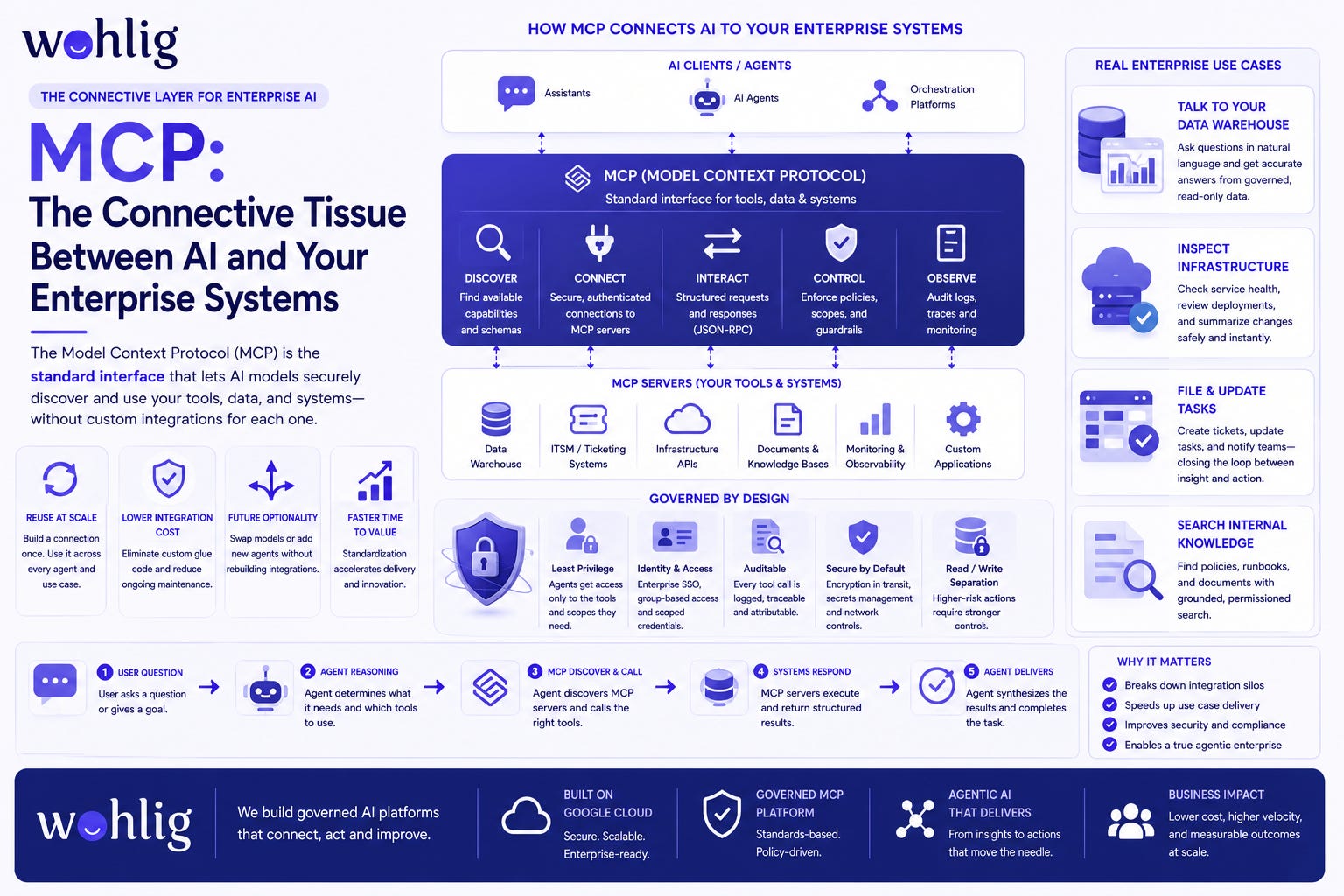
At its simplest, MCP is a standard interface between models and tools. Instead of hand-wiring each model to each system, you expose your systems as MCP servers that describe what they can do in a consistent way. Any MCP-aware client — an assistant, an agent, or an orchestration layer — can then discover those capabilities and use them through the same protocol.
Think of it as a common port that every tool can plug into. The model doesn’t need to know the internals of your data warehouse or your infrastructure APIs. It only needs to know that a tool exists, what it accepts and what it returns. That separation is why MCP has moved so quickly from an interesting idea to something enterprise teams now ask for by name.
Why standardisation matters more than any single tool
Standards are rarely exciting on their own, but they’re what turn scattered capability into leverage. Before a common protocol, every new AI use case carried an integration tax. Teams rebuilt the same connections in slightly different ways, and each rebuild added surface area to maintain and secure.
A shared protocol collapses that cost. When your systems speak MCP, a tool you expose once becomes available to every agent and assistant that follows the standard. You build a connection to your data warehouse a single time, and it works across use cases you haven’t even scoped yet.
For engineering leaders, the practical benefit is reuse: your investment in connecting a system compounds instead of resetting with each new model or framework. For CTOs, the strategic benefit is optionality. Standardised interfaces reduce the cost of switching models or adding new agent capabilities, which keeps you from being locked into a single vendor’s roadmap.
Governance and least-privilege scoping
The moment an AI agent can call real tools, it can also take real actions — and that raises the questions your security and compliance teams will ask first. What can this agent see? What can it change? And how do you prove it later?
MCP makes those questions answerable because it gives you a clear boundary to govern. Every tool an agent can reach passes through a defined interface, which is exactly the place to apply controls. The right posture is least privilege: an agent should have access only to the specific tools and scopes its task requires, and nothing more. A support agent that files tickets doesn’t need write access to production infrastructure. A reporting agent that reads the data warehouse doesn’t need permission to delete anything.
Practical governance of an MCP estate rests on a few disciplines. Curate a catalogue of approved tools rather than letting connections proliferate ad hoc. Scope credentials tightly and tie them to identity, so actions are attributable. Log every tool call for audit. And separate read-only capabilities from those that mutate state, so the higher-risk actions carry stronger controls and, where appropriate, human approval. These are the same principles that govern any privileged system, applied to a new kind of caller.
Real enterprise use cases
The value of MCP becomes concrete in the everyday work it unlocks. A few patterns show up repeatedly across enterprises.
Talk to the data warehouse. Instead of routing every analytical question through a queue of analysts, teams can ask in natural language and let a governed agent translate that into queries against approved datasets. The agent reads through a scoped, read-only interface and never touches data it shouldn’t see.
Inspect infrastructure. Engineers can ask an agent to check the health of a service, summarise recent changes, or surface the state of a deployment. The agent reads from monitoring and infrastructure systems through MCP tools deliberately limited to observation, keeping diagnosis fast and safe.
File and update tasks. When an agent identifies an issue or completes a step, it can create a ticket, update a task, or notify the right channel — closing the loop between insight and action without a human retyping what the agent already knows.
What ties these together is that the model provides the reasoning while MCP provides the reach. The intelligence decides what to do, and the protocol gives it a safe, standard way to do it inside your systems.
How Wohlig wires governed MCP on Google Cloud
Getting to this outcome is less about the protocol itself and more about the discipline around it — and that’s the work Wohlig does. We help enterprises design and operate governed MCP tool catalogues on Google Cloud, so your agents can act across your systems with the controls your organisation requires.
In practice, that means identifying the tools worth exposing, wrapping your data platforms, infrastructure and operational systems as well-scoped MCP servers, and building the identity, permissioning and audit layers around them. We enforce least privilege by default and make every action observable. Because we build natively on Google Cloud, this fits alongside the data platforms, security posture and developer tooling you already run there.
If you’re ready to move from AI demos to agents that do useful, governed work, a governed MCP tool catalogue is the foundation. Talk to Wohlig about designing yours on Google Cloud.