

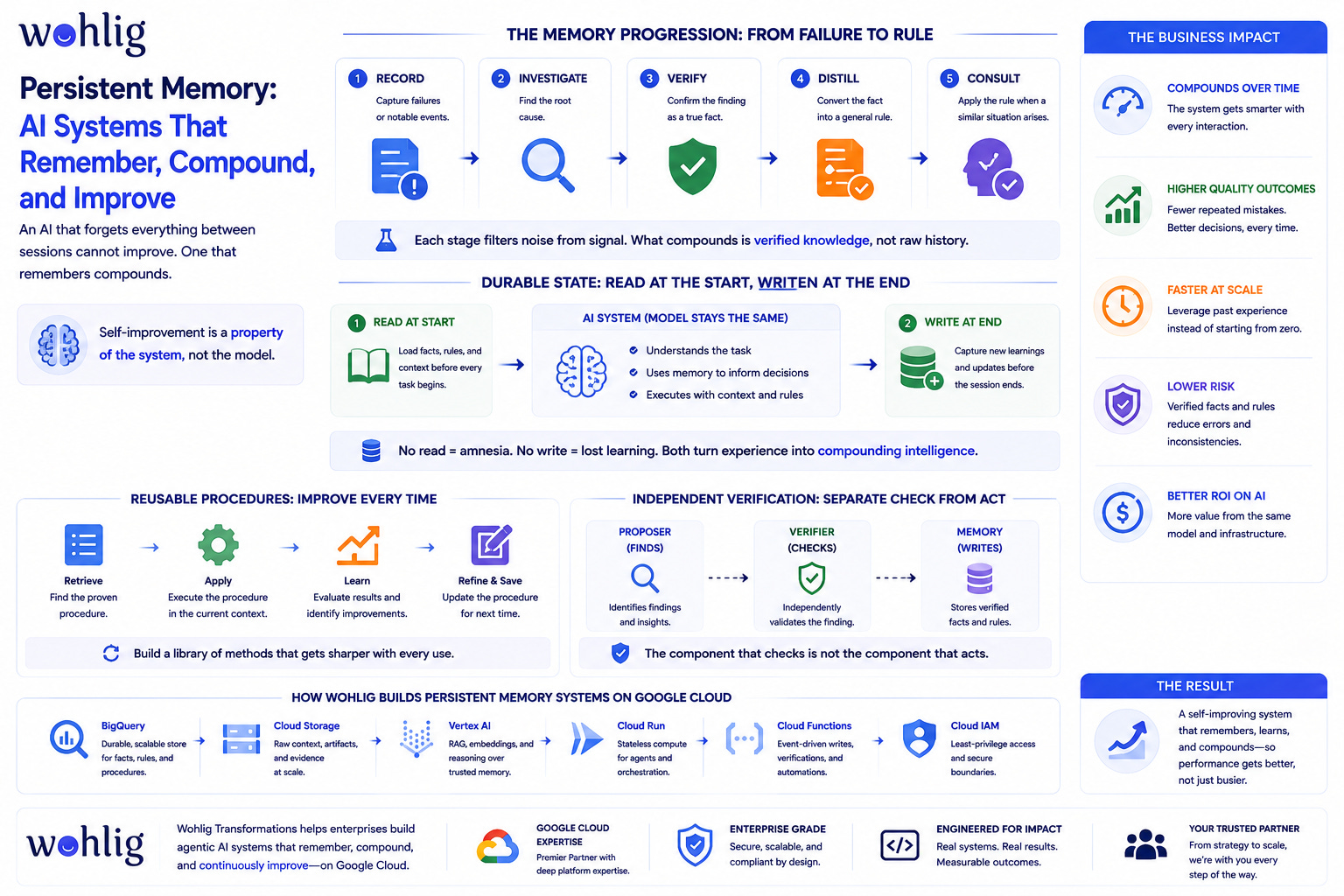
Most enterprise AI systems reset to zero after every interaction. They repeat the same mistakes indefinitely, because nothing they learn in one session survives into the next. The frontier trend in 2026 is the fix for exactly that: AI persistent memory — systems that record what happened, verify it into durable facts, distil those facts into reusable rules, and consult that knowledge the next time round.
This is self-improvement, and the crucial thing to understand about it is that it’s a property of the system, not the model.
Self-learning is not self-improvement
The two terms get used interchangeably, and the confusion is expensive. Self-learning means updating the model weights: retraining or fine-tuning so the underlying network changes. That’s slow, costly, hard to govern, and rarely what an enterprise actually needs. It also doesn’t explain how a system gets better between two runs of the same fixed model.
Self-improvement is different. Here the model stays constant, and the system around it compounds. The intelligence doesn’t live only in the weights; it lives in what the system has accumulated, written down, and can read back. A frozen model paired with a growing body of verified knowledge outperforms the same model working from a blank slate every time. The lesson for AI leaders is direct: you don’t have to touch the model to make the system smarter. You have to give it a memory.
The memory progression: from failure to rule
Persistent memory isn’t a transcript log. A dump of past conversations is noise, and feeding it back verbatim degrades performance rather than improving it. What compounds is a disciplined progression that turns raw experience into knowledge the system can trust.
The progression looks like this. First, the system records a failure or a notable event — something didn’t work, or worked in a surprising way. Second, it investigates the cause rather than reacting to the symptom. Third, it verifies the finding into a fact, confirming the cause is real and reproducible rather than a one-off coincidence. Fourth, it distils that fact into a rule — a compact, general statement of what to do or avoid. Fifth, and most important, it consults that rule the next time a similar situation arises.
Each stage filters signal from noise. A single failure is an anecdote. A verified fact is evidence. A distilled rule is reusable judgement. By the time knowledge reaches the rule stage, it’s small, general and safe to apply — which is exactly what keeps the accumulated memory from bloating into an unusable pile.
Durable state: read at the start, written at the end
For any of this to work, the system needs somewhere to keep what it knows between sessions, and a discipline for using it. We call this durable state: a persistent record of facts, rules and context that survives across runs.
The operating pattern is simple and strict. Durable state is read at the start of every task, so the system begins already knowing what it learned before, and it’s written at the end, so anything new is captured before the session closes. Without the read step, the system is amnesiac by default. Without the write step, hard-won lessons evaporate the moment the interaction ends. Getting both halves right is what separates a system that compounds from one that merely appears busy.
Durable state also needs structure and hygiene. It should be curated, deduplicated and pruned, because stale or contradictory entries actively mislead. Good memory isn’t the largest memory. It’s the most trustworthy.
Reusable procedures and independent verification
Facts and rules are the passive layer of memory. The active layer is reusable procedures: encoded, repeatable ways of doing recurring work, refined every time they run. When a system encounters a task it has solved well before, it shouldn’t reinvent the approach. It should retrieve the proven procedure, apply it, and improve it if the outcome suggests a better path. Over time the system builds a library of methods that get sharper with use — compounding in its most tangible form.
None of this is safe without independent verification. Memory that writes itself unchecked will confidently preserve its own mistakes, and a wrong rule consulted repeatedly is worse than no rule at all. So the promotion of a finding into a durable fact, and a fact into a rule, must be gated by a verification step separate from the step that produced it. The component that checks is not the component that acts. That separation is what keeps a self-improving system honest, and it’s the difference between compounding knowledge and compounding error.
Put these pieces together and the headline holds: self-improvement is a property of the system, not the model. The weights never changed. The system got better because it remembered, verified and reused.
How Wohlig helps
Wohlig Transformations is a Google Cloud transformation and AI partner. We design and build agentic AI systems that carry durable state across sessions, capture verified facts and rules, encode reusable procedures, and gate every promotion with independent verification — all engineered on Google Cloud so the system genuinely improves the longer it runs.
If your AI initiatives reset to zero after every interaction, we can help you build systems that remember and compound instead. Talk to Wohlig about engineering persistent memory and self-improving AI on Google Cloud.