

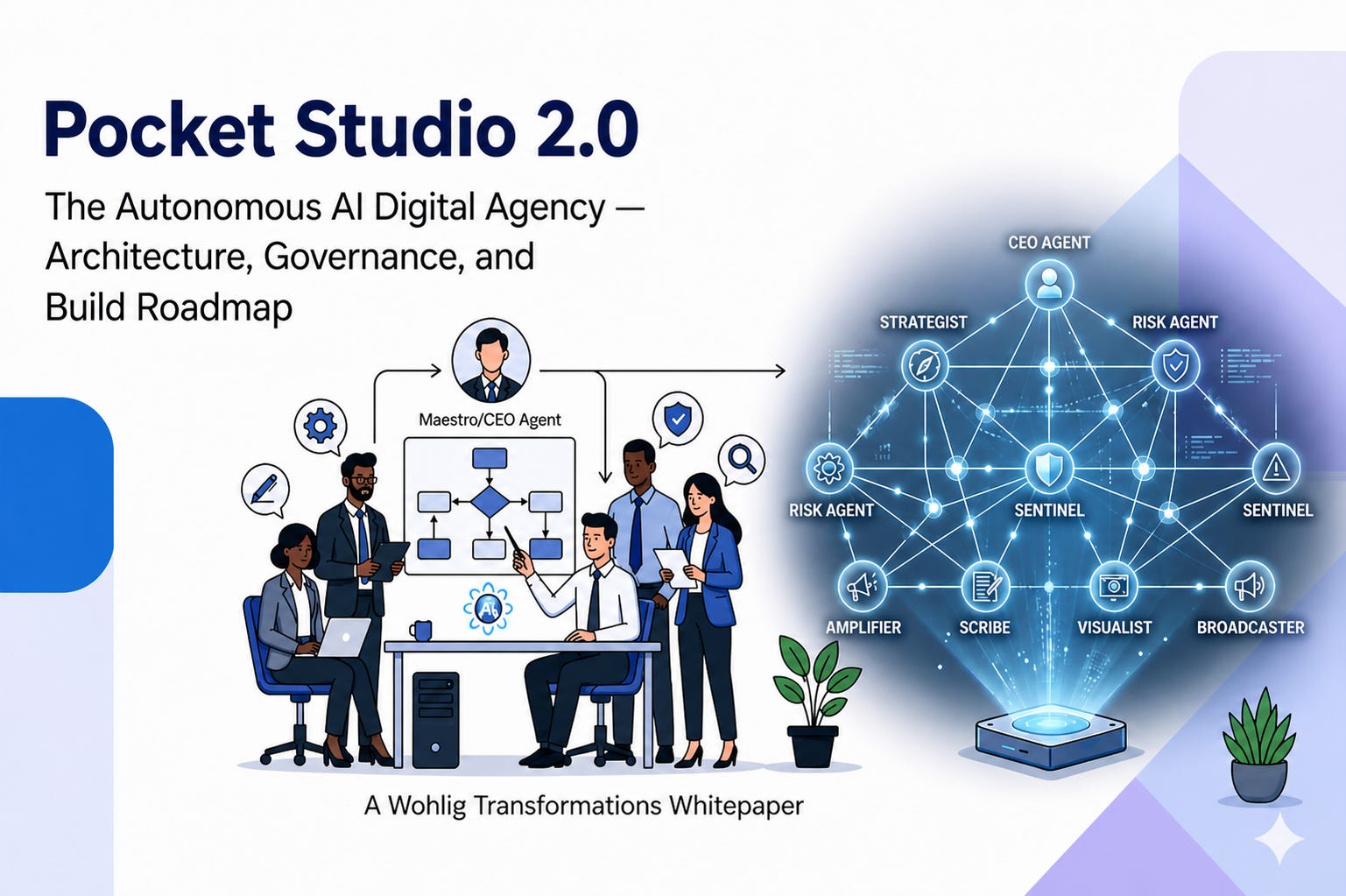
A Wohlig Transformations Whitepaper
Executive Summary
Pocket Studio 2.0 is Wohlig’s flagship AI product: a fully autonomous digital agency built as eighteen specialist AI agents arranged in a five-tier corporate hierarchy. It covers every discipline a top global agency offers — strategy, research, creative production (copy, image, video, audio), SEO, paid media, PR, influencer marketing, community management, landing pages, CRO, marketing automation, analytics, and client servicing — and it runs them autonomously, end-to-end, from a single client brief to a live, compliant, optimized, continuously improving campaign.
This whitepaper documents the architecture, the governance model, the agent capability profiles at a summary level, the campaign execution flow, the technology stack, the phased build roadmap, and the go-to-market strategy.
At a Glance:
Specialist agents: 18
Org-chart tiers: 5 (Board → CEO → C-Suite → VP → Specialist)
Agency capability coverage: 100% (zero gaps vs. top global agencies)
Build phases: 3, total ~12 months
System cost per client: very low — see commercial section
Infrastructure: Google Cloud Platform (data sovereignty)
Client pricing: ₹1.5L (Phase 1) → ₹5L+ (Phase 3) per month
1. Why a New Architecture is Required
The current AI marketing landscape is a graveyard of point tools. One vendor automates copy. Another automates images. A third schedules posts. None connect. None enforce brand. None audit themselves. None respect regulatory boundaries for BFSI, pharma, education, or real estate. None survive a serious enterprise procurement review.
A real digital agency is not a sequence of tools. It is a company — with strategists, creatives, performance leads, account managers, and a quality and compliance discipline that runs through every output. To replace it, you must architect a company, not a feature set.
That is what Pocket Studio 2.0 is.
2. The Five-Tier Hierarchy
Every agent has a title, a manager, reporting lines, a monthly budget, and a heartbeat schedule. The hierarchy is enforced at the platform level — agents can only delegate downward and escalate upward.
Tier 0 — Board (Human Governance Layer). Wohlig account team plus client stakeholders. Approves strategy, overrides agents, sets budgets, reviews QBRs. Notified via WhatsApp for every approval gate.
Tier 1 — CEO Agent (Maestro). Receives briefs, parses them, opens sub-tickets to department heads, manages revisions, escalates blockers to the board, routes deliverables through compliance and client approval.
Tier 2 — C-Suite (3 agents).
Strategist — Chief Strategy Officer.
Sentinel — Chief Compliance Officer.
Diplomat — Chief Client Officer.
Tier 3 — VP / Director Layer (8 agents). Functional heads for research, brand monitoring, performance analytics, infrastructure, paid media, PR, marketing automation, and community.
Tier 4 — Specialist / IC Layer (6 agents). The execution layer — copywriting, art direction, video production, web engineering, influencer management, and community engagement.
3. Agent Capability Coverage
The eighteen agents collectively cover the full service catalog of a top global agency. A summary view:
Strategy & planning — Strategist + Oracle-Market + Oracle-Pulse
Creative — copy, design, video — Scribe + Visualist + Director + Builder
SEO & performance marketing — Amplifier (Google, Meta, LinkedIn, programmatic, ASO)
PR & earned media — Publicist (wire, media relations, crisis)
Influencer marketing — Influencer (discovery, outreach, UGC pipeline)
Community & social management — Engager (comments, DMs, reviews, communities)
Marketing automation & CRM — Automator + Nexus (scoring, lifecycle, ABM)
Web production & CRO — Builder (pages, technical SEO, CRO, Core Web Vitals)
Analytics & reporting — Analyst + Diplomat (daily reports, QBR decks)
Account management — Maestro + Diplomat + Sentinel (orchestration, compliance, comms)
A formal agency capability gap audit confirmed zero gaps across content & copywriting, creative production, distribution & publishing, paid media & performance, web & SEO, intelligence & research, community & engagement, PR & communications, marketing automation & CRM, analytics & reporting, and client servicing & account management.
4. The Orchestration Layer
Pocket Studio 2.0 runs on a self-hosted, open-source orchestration platform that models the system as a company rather than a workflow. This layer provides:
Org chart enforcement — agents cannot operate outside their authority.
Heartbeat scheduling — agents wake on the right cadence for their job (continuous, reactive, or batched).
Ticket system — every task is a ticket with full goal ancestry, parent-child relationships, message thread, and tool-call trace.
Budget control — each agent has a hard monthly token budget enforced automatically. No runaway spend.
Governance — the board can pause, override, reassign, or terminate any agent at any time. Approval gates are enforced at the platform level, not through agent logic.
Goal alignment — every action carries lineage back to the original client brief. Agents always know why they are doing what they are doing.
Multi-company — one platform install runs many client companies in parallel with complete data isolation. Wohlig operates a single control plane for the entire portfolio.
Skill discovery — runtime context (brand guidelines, campaign history, compliance rulesets, client preferences) discoverable on demand by agents — no need to inject into every prompt.
Without this layer, Wohlig’s engineering team would have to build — from scratch — a stateful campaign management system, agent routing engine, budget enforcement layer, audit logging system, multi-tenant isolation, board approval workflow, and a heartbeat scheduler. The orchestration platform provides all of this off the shelf, saving 4–6 months of senior engineering time in Phase 1 alone.
5. Heartbeat Schedules
Three categories of agent wakeup logic, optimized for cost and responsiveness:
Continuous agents wake every 2–8 hours for monitoring and publishing tasks. Brand-monitoring runs every 4 hours. Publishing queue checks every 2 hours. Comment moderation every 2 hours. Lead score evaluation every 6 hours. Paid media review every 8 hours.
Reactive agents wake only when a ticket is assigned — zero idle activity. CEO, Strategist, Compliance, Copywriter, Visualist, Director, Influencer, and Client Officer.
Scheduled agents wake on fixed daily or weekly cadence for batch analytics — daily 6 AM analytics aggregation, weekly Monday 7 AM CRO and heatmap analysis.
This pattern keeps token spend predictable and gross margins very strong even at low client price points.
6. End-to-End Campaign Execution Flow
Brief received → Maestro parses, opens ticket #001
   │
   ▼
Oracle-Market → 20–30 min pre-campaign intelligence (competitive,
                 audience, market, channel)
   │
   ▼
Strategist → builds full campaign plan (channel mix, calendar, KPIs,
              creative briefs, influencer plan, ABM list, automation
              flows)
   │
   ▼
[ Board Approval Gate 1 — Strategy ]   ← enforced at platform level
   │
   ▼
Scribe / Visualist / Director / Builder / Influencer
              → parallel creative production
   │
   ▼
Sentinel → compliance screen on every asset
              (brand DNA + regulatory ruleset)
   │
   ▼
[ Board Approval Gate 2 — Creative review ]   ← enforced at platform
   │
   ▼
Broadcaster + Amplifier + Builder → live distribution
              (social, paid, programmatic, page launch, GTM)
   │
   ▼
Analyst + Oracle-Pulse → continuous performance monitoring,
                          creative fatigue, brand sentiment
   │
   ▼
Diplomat → weekly client report + monthly executive summary +
            quarterly business review deck
   │
   ▼
Analyst → historical learning brief stored in client knowledge base
            and surfaced to Strategist on the next brief
A real example: a single client brief for a course launch campaign generates 22 tickets across 18 agents — every one logged, every one traceable from any leaf back to the original brief.
7. Compliance — Built In, Not Bolted On
Sentinel screens every asset before it advances. Regulatory rulesets covered:
India — ASCI (general advertising), RBI / SEBI / IRDAI (BFSI), Drugs & Magic Remedies Act and FSSAI (pharma & food), RERA (real estate), Cable TV Networks Act, plus state-level regulations (Kerala lottery, Maharashtra RERA, alcohol advertising rules).
International — UK ASA, UAE NMC, US FTC influencer disclosure rules.
Every influencer post is screened for the correct disclosure format per market — #ad in India, #ad in UK, #sponsored / #ad in US.
Any asset that fails compliance is rejected automatically with an annotated reason and a revision ticket opened to the originating agent. Sentinel runs on every asset — no exceptions. Compliance clearance certificates are issued in the ticket system.
This is the single capability that closes enterprise deals in regulated sectors.
8. Analytics & Intelligence
Three agents own the complete analytics picture:
Oracle-Market — pre-campaign intelligence (competitive, audience, market, channel) — runs per brief and on monthly refresh.
Oracle-Pulse — always-on monitoring (brand sentiment, competitor ads, viral trends, review platforms) — 4-hour heartbeat.
Analyst — post-campaign performance (campaign metrics, creative fatigue, SEO, attribution & ROI, predictive analytics, historical learning brief) — daily, weekly, monthly, and per-campaign-end.
The historical learning brief is the system’s compounding advantage — every campaign makes the next one measurably smarter for that client.
9. Web, SEO & CRO
The Builder agent owns every functional web output: landing page production (HTML/CSS, Webflow, Framer, Unbounce, WordPress exports), A/B variants, technical SEO on every page (meta, schema, canonicals, hreflang, internal linking), Core Web Vitals audit (LCP < 2.5s, CLS < 0.1, INP < 200ms), CRO monitoring (heatmap, scroll, form abandonment, A/B tests), full GTM container setup, and HTML5 animated banner production.
Every landing page goes through a structured 9-step pipeline across 6 agents with two human approval gates — brief, research, brand & compliance load, copy, visuals, page assembly, compliance screen, client approval, live with continuous CRO monitoring.
10. Phased Build Roadmap
Phase 1 — Months 1–4 — Core Intelligence & Orchestration. Orchestration platform on GCP. 8 foundational agents (Maestro, Oracle-Market, Oracle-Pulse, Sentinel, Scribe, Diplomat, Strategist, Builder basic). Brief-to-brand-compliant-copy-and-creative delivered via WhatsApp approval. Priced at ₹1.5–2L per client per month. Two or three pilot clients fund Phase 2.
Phase 2 — Months 5–8 — Full Creative Production & Distribution. All creative production agents online — Visualist, Director, Builder full, Broadcaster, Amplifier, Analyst, Influencer (basic), Client Portal v2. End-to-end autonomous. Priced at ₹3.5–5L per client per month.
Phase 3 — Months 9–12 — Scale, Automation, Community & PR. Influencer full, Engager, Publicist, Automator. All 11 agent extensions. Programmatic via DV360 and The Trade Desk. Enterprise CRM and CDP integrations. White-label mode. GCP Marketplace package. Priced at ₹5L+ or outcome-based for enterprise.
Each phase ships something usable and billable while the next layer builds on top.
11. Technology Stack (Summary)
Infrastructure — Google Cloud Platform: GKE for agent containers, Cloud Run for portal endpoints, Firestore for state, BigQuery for analytics, Cloud Storage for assets, Pub/Sub for events, Cloud Tasks for heartbeats, Looker Studio for client dashboards, Secret Manager, Cloud Armor, IAP.
Creative production — best-in-class image, video, and voice generation tools, selected per agent for the job.
Research & comms APIs — Tavily, Perplexity, SEMrush, SerpAPI, Brandwatch, Sprinklr, HypeAuditor, Modash, Muck Rack, Cision, PR Newswire, Meta Graph API, WhatsApp Business API, Google Ads API, LinkedIn Marketing API, DV360 + The Trade Desk, HubSpot, Salesforce Marketing Cloud, Marketo, Twilio, Kaleyra, SendGrid.
Multi-tenant on GCP — each client company is a separate namespace with isolated org chart, brand database, agent budgets, and audit logs.
12. Team Structure
Total engineering team at full build: 14 people.
Phase 1 (6 people) — 1 AI/ML engineer, 2 backend engineers, 1 frontend engineer, 1 product manager, plus shared leadership.
Phase 2 additions (4 people) — creative tech engineer, integrations engineer, data engineer, web engineer.
Phase 3 additions (4 people) — PR & community engineer, CRM & automation engineer, DevOps / platform engineer, enterprise solutions engineer.
13. Go-to-Market and Commercial Logic
Pocket Studio 2.0 is not priced as software seats. It is priced as a replacement for an agency relationship.
Phase 1 — Primary segment: GCP customers spending ₹15–25L/month on external agencies — Pricing: ₹1.5–2L / month (Starter)
Phase 2 — Primary segment: Fast-growth D2C, EdTech, fintech needing full creative & multi-channel — Pricing: ₹3.5–5L / month (Growth)
Phase 3 — Primary segment: Enterprise multi-brand replacing agency relationships — Pricing: ₹5L+ / month or outcome-based
A mid-size agency retainer is ₹15–25L/month for comparable output. Pocket Studio 2.0 at ₹3.5–5L/month — with 24×7 operation, audit-grade governance, regulatory compliance, and full data sovereignty — closes the ROI conversation for almost every prospect in the target segment.
14. Competitive Moat
Three structural advantages:
The compliance engine. No competitor screens for SEBI, IRDAI, FSSAI, RERA, ASCI, UK ASA, UAE NMC, and US FTC simultaneously. Building this takes 12–18 months and deep regulatory expertise per sector. It is mandatory for BFSI and pharma — India’s largest marketing spenders.
Full data sovereignty on GCP. Every competitor sends client data to their own SaaS cloud. Pocket Studio 2.0 lives in the client’s own GCP project. For banks, insurers, pharma, and government-adjacent organizations, this is non-negotiable.
End-to-end campaign autonomy. Every competitor automates a fragment. Pocket Studio 2.0 automates the entire agency relationship — brief to live campaign to performance report to next brief — with compliance built into every step.
Multi-year head start, on a moat that compounds with every client campaign.
15. About Wohlig
Wohlig Transformations is a digital transformation, cloud, and AI consulting firm founded in 2016. We have shipped 10+ generative-AI solutions in production, completed 20+ cloud migrations, and hold 40+ Google Cloud certifications including a Data Analytics specialization. We serve governments (Maharashtra, Gujarat, ONDC), enterprises (Lodha, Eros Now, Hungama), and high-growth consumer companies (Swiggy, Ninjacart, PW Live).
Offices: India and London. Web: www.wohlig.com.
To discuss Pocket Studio 2.0 for your brand or agency, reach Wohlig at chintan@wohlig.com.