

Wohlig Transformations · Product Engineering
For the last five years, the answer to “we need to edit video” has
been: pay $20–$50 per seat per month to one of a dozen browser-based
SaaS editors. Veed. Kapwing. Descript. Canva Video. The footage gets
uploaded to their cloud, edited there, rendered there, and downloaded
back. The seats multiply. The bill grows. And every BFSI, healthcare,
and legal customer who tries to use any of them runs into the same
brick wall: we cannot send raw client footage to a third-party
multi-tenant cloud.
Meanwhile, every D2C brand and ed-tech platform with serious
content velocity has the opposite problem — they want to embed a
video editor inside their own product so creators do not bounce out
to a separate tool. Building one from scratch is a 12–18 month
engineering exercise that nobody can spare the team for.
Wohlig builds the way out of both problems. We call it a Private
Video Editor.
What it is
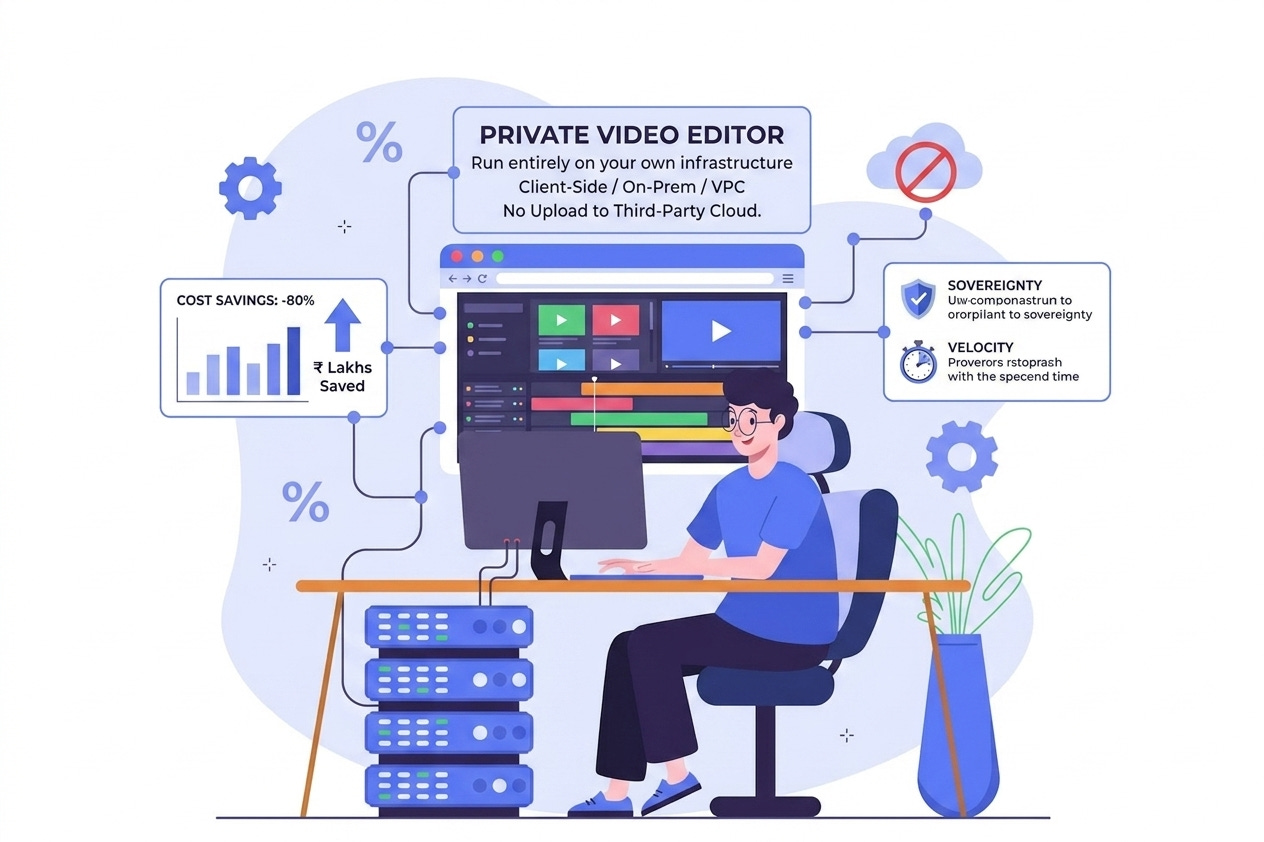
A browser-based, multi-track video editor that runs entirely on the
client side. Users open a URL. They drag video, audio, images, and
text onto a multi-track timeline. They trim, split, duplicate, layer.
They preview in real time. They export to MP4 up to 1080p. The entire
encoding pipeline runs in the browser through WebAssembly. No upload
to a third-party cloud. No rendering backend.
That last property is the one that closes deals. The footage never
leaves the user’s machine — or, in the deployed-internally version,
never leaves the customer’s network. There is nothing to leak. There
is no third-party data-processing agreement to negotiate. The CISO
signs off in one meeting.
Wohlig deploys this in two patterns:
Pattern A — Embedded inside your product. A SaaS, ed-tech, or
creator-economy platform gets a fully white-labeled editor running
inside its own UI. Branded. Themed. Wired into the product’s auth and
storage. A capability the product team would otherwise spend
12–18 months building.
Pattern B — Private corporate editor. A regulated enterprise
gets a self-hosted editor, deployed in the customer’s VPC or on-prem,
gated by SSO. Marketing, internal comms, sales enablement, training
— all the corners of the business that produce video — get a tool
they can actually use without uploading content to an external SaaS.
Where it wins
1. Cost. A 100-seat creator team at ₹2,500/seat/month is paying
~₹30 lakh per year in SaaS video subscriptions. The private editor
costs the deployment infrastructure plus a one-time engineering
engagement.
2. Sovereignty. Footage never leaves the customer’s perimeter.
For BFSI client testimonial videos, healthcare patient content,
legal recordings, and government communications, this is the
unblocker.
3. Velocity. Marketing teams stop waiting for an agency to turn
around a 30-second cut. Sales teams record and trim demo clips
themselves. Ed-tech instructors edit lecture footage between
classes. Internal comms teams cut town-hall recaps in an hour.
4. White-label revenue line. SaaS companies in the creator,
ed-tech, podcast, and short-video adjacent categories add an
embedded editor as a feature — without building it from scratch.
Differentiates the product, eliminates the bounce-out to an external
tool, increases time-in-product.
5. Extensibility. Once the foundation is in place, Wohlig can
layer AI features on top: auto-cut on silence for podcasts,
transcript-driven editing for interviews, auto-captioning, brand-
consistent intro/outro stitching, generative B-roll, batch export
for ad creatives at every aspect ratio.
Where this fits
D2C and e-commerce brands producing high-volume product reels,
UGC edits, and ad creatives — and bleeding ROAS waiting on
external production cycles.Creator-economy and short-form-video SaaS wanting an embedded
editor as a feature module.Ed-tech and L&D platforms where instructors trim lectures,
add captions, and assemble lesson videos in-browser.Internal corporate comms / HR / IC teams at large enterprises
producing town halls, onboarding, and training clips.Digital agencies and MarTech vendors wanting a white-label
editor inside client portals.Media, news, and sports orgs that need fast clip-and-publish
workflows.
What Wohlig actually delivers
The browser-based foundation is open-source and client-side. What
Wohlig brings is the production engineering that turns it into a
real platform:
Custom branding, theming, and product integration.
Auth, identity, storage, and DAM/CMS hooks.
Server-side render farm for 4K, long-form, and batch jobs that
exceed browser limits.AI features — auto-captioning, silence detection, transcript-
driven cutting, generative B-roll, brand asset enforcement.Aspect-ratio presets for Reels, Shorts, YouTube, OTT, and
programmatic display.One-click export pipelines into the customer’s content stack.
VPC / on-prem deployment for regulated environments.
Performance tuning for long timelines and large media libraries.
The honest summary
The video tooling industry has spent five years quietly billing
enterprises for the privilege of uploading their own footage to
someone else’s cloud. The technology to run a serious editor
entirely in the browser, or entirely inside a private network, is
now mature enough to flip that equation.
If you are paying per-seat for video SaaS — or if you are about to
build an editor inside your own product — Wohlig has the
foundation, the engineering, and the deployment patterns to do it
better, faster, and on infrastructure you actually own.
Wohlig Transformations builds AI, cloud, and data platforms for
governments, enterprises, and high-growth startups. 10+ generative-AI
solutions in production. 40+ Google Cloud certifications. Founded
2016. Offices in India and London.