

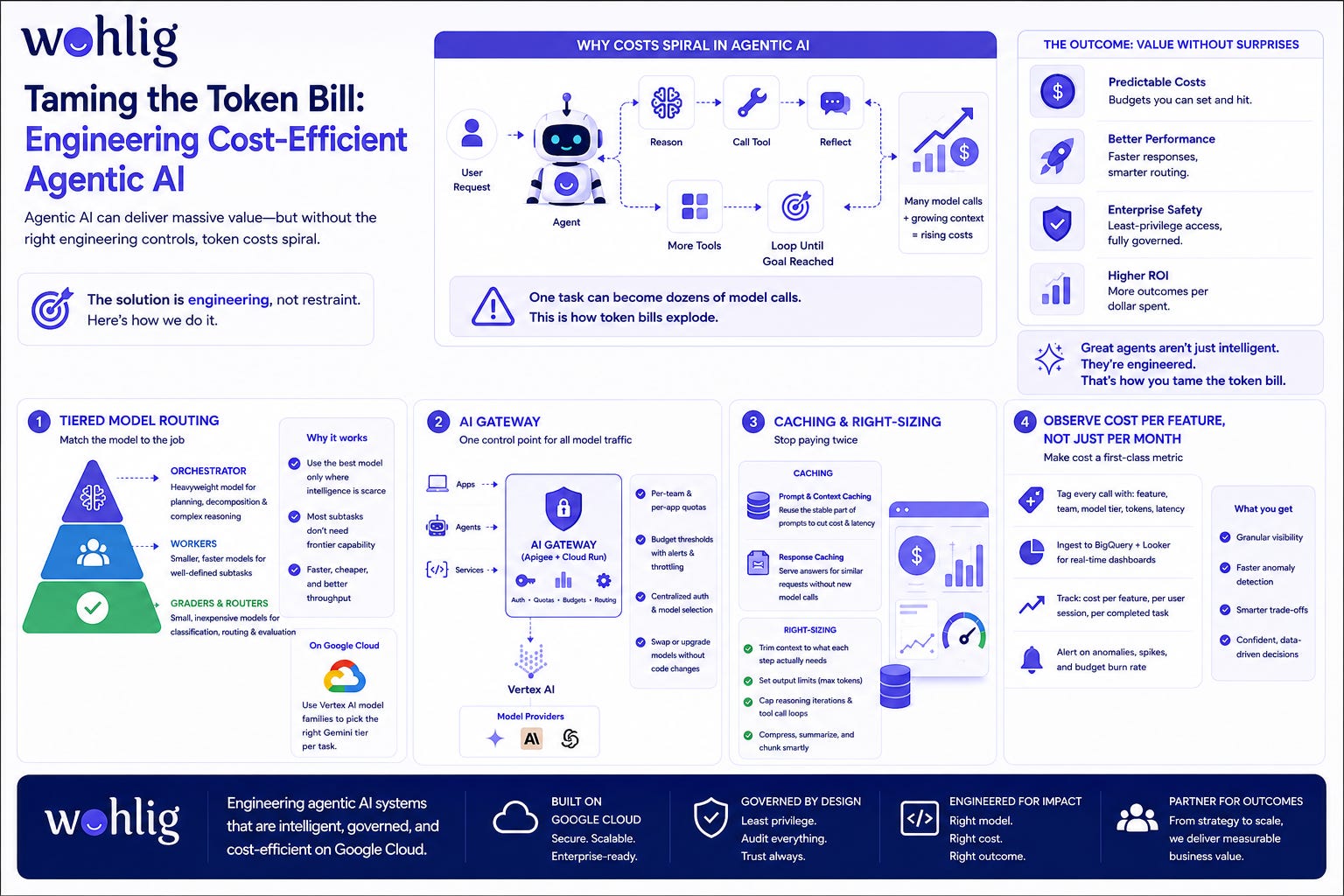
Something changed when enterprises moved from single-prompt AI features to genuine agents. A chatbot answers once. An agent reasons, calls tools, reflects on the result, calls more tools, and loops until it reaches a goal. Each of those steps is a model invocation, and each invocation carries the full weight of accumulated context. A task that looks like one user request can quietly become dozens of model calls.
Through 2026 this produced a recognisable pattern that engineers started calling “tokenmaxxing”: teams shipping agents that worked beautifully in a demo, then watching monthly spend climb far past forecast once real traffic arrived. The culprit was rarely a single expensive call. It was volume, redundancy, and the habit of routing every step — however trivial — to the most capable and most expensive model available.
The good news is that AI cost optimisation is now a well-understood engineering problem. Costs don’t spiral because agents are inherently expensive; they spiral because most systems are built without the controls that make cost predictable. The fix is engineering, not restraint. Here’s how we design those controls.
Tiered model routing: match the model to the job
The single largest lever is refusing to use one model for everything. Agentic workflows contain a mix of tasks with wildly different difficulty, and paying premium rates for easy work is where budgets quietly bleed.
A well-architected agent uses a tiered approach. A heavyweight model acts as the orchestrator: it handles planning, decomposition, and the hard reasoning that genuinely needs frontier capability. Lighter, faster models act as workers, executing the well-defined subtasks the orchestrator hands down — extraction, summarisation, formatting, or straightforward tool calls. And small, inexpensive models act as graders and routers, classifying intent, checking whether an answer meets a bar, or deciding which path a request should take.
This isn’t a compromise on quality. Most subtasks in a real workflow don’t require the strongest model, and using a smaller one often makes them faster as well as cheaper. The orchestrator spends its budget where reasoning is scarce, and the rest of the system runs lean. On Google Cloud, the Vertex AI model families make this practical: you can select the right Gemini tier per task and keep them behind a consistent interface.
An AI gateway: quotas, budgets and a single control point
You can’t govern what every service calls independently. When each team wires its own model calls directly, there’s no place to enforce a limit, no shared view of spend, and no way to react when something goes wrong.
An AI gateway solves this by routing all model traffic through one managed layer, and that layer becomes where policy lives. It enforces per-team and per-application quotas so a single misbehaving loop can’t consume a quarter’s budget overnight. It applies budget thresholds that trigger alerts, throttling or graceful degradation before an invoice becomes a crisis. And it centralises authentication and model selection, so upgrading or swapping a model is a configuration change rather than a code migration across dozens of services.
On Google Cloud, we build these gateways using Apigee and Cloud Run, integrated with Vertex AI, so that governance, rate limiting and budget enforcement sit in front of every agent. The gateway also becomes the natural home for the next two practices: caching and observability.
Caching and right-sizing: stop paying twice
A large share of agentic token spend is pure repetition. Agents re-send the same system instructions, the same tool definitions and the same reference context on every call in a loop, and they regenerate answers to questions that were answered minutes ago.
Two techniques address this directly. Prompt and context caching lets the model reuse the stable portion of a prompt instead of reprocessing it every time, which cuts both cost and latency on the long, unchanging preamble that dominates many agent calls. Response caching, keyed on semantically similar requests, means common queries are served without a model call at all.
Right-sizing is the discipline that surrounds this. It means trimming context to what a step actually needs rather than passing the entire history forward, setting sensible output limits so the model doesn’t ramble, and capping the number of reasoning iterations an agent may take before it must return or escalate. Much of the worst spend comes from unbounded loops and bloated context windows, and both are preventable with deliberate limits.
Observe cost per feature, not just per month
The invoice at the end of the month tells you that you spent too much. It doesn’t tell you where, why, or whether the spend was worth it. Without granular attribution, every optimisation is guesswork.
Cost-efficient AI requires observability that ties spend to meaning. That means instrumenting every model call with the feature it served, the team that owns it, the model tier it used, and the token counts it consumed. With that data flowing into your telemetry, cost becomes a first-class metric alongside latency and error rate. You can see cost per feature, cost per user session and cost per completed task — and watch those numbers move as you tune the system.
On Google Cloud, we route this telemetry into Cloud Logging and BigQuery, then surface it in dashboards that engineering and finance can read together. That shared view turns AI cost optimisation from an occasional fire drill into a continuous practice, and it lets leaders make honest decisions about which agentic features earn their keep.
How Wohlig helps
Wohlig Transformations is a Google Cloud transformation and AI partner. We build agentic AI, cloud platforms, data and BI systems, and internal developer platforms for enterprises — and we design them to be economically sustainable from the start. That means tiered model routing on Vertex AI, an AI gateway built on Apigee and Cloud Run for quotas and budgets, caching and right-sizing baked into the architecture, and cost observability wired into BigQuery so you always know what your agents cost and why.
If your agent bills are outrunning your forecasts, or you want to launch agentic capabilities without that risk, we can help you engineer for both capability and cost. Reach out to Wohlig to design cost-efficient agentic AI on Google Cloud that stays viable as you scale.