

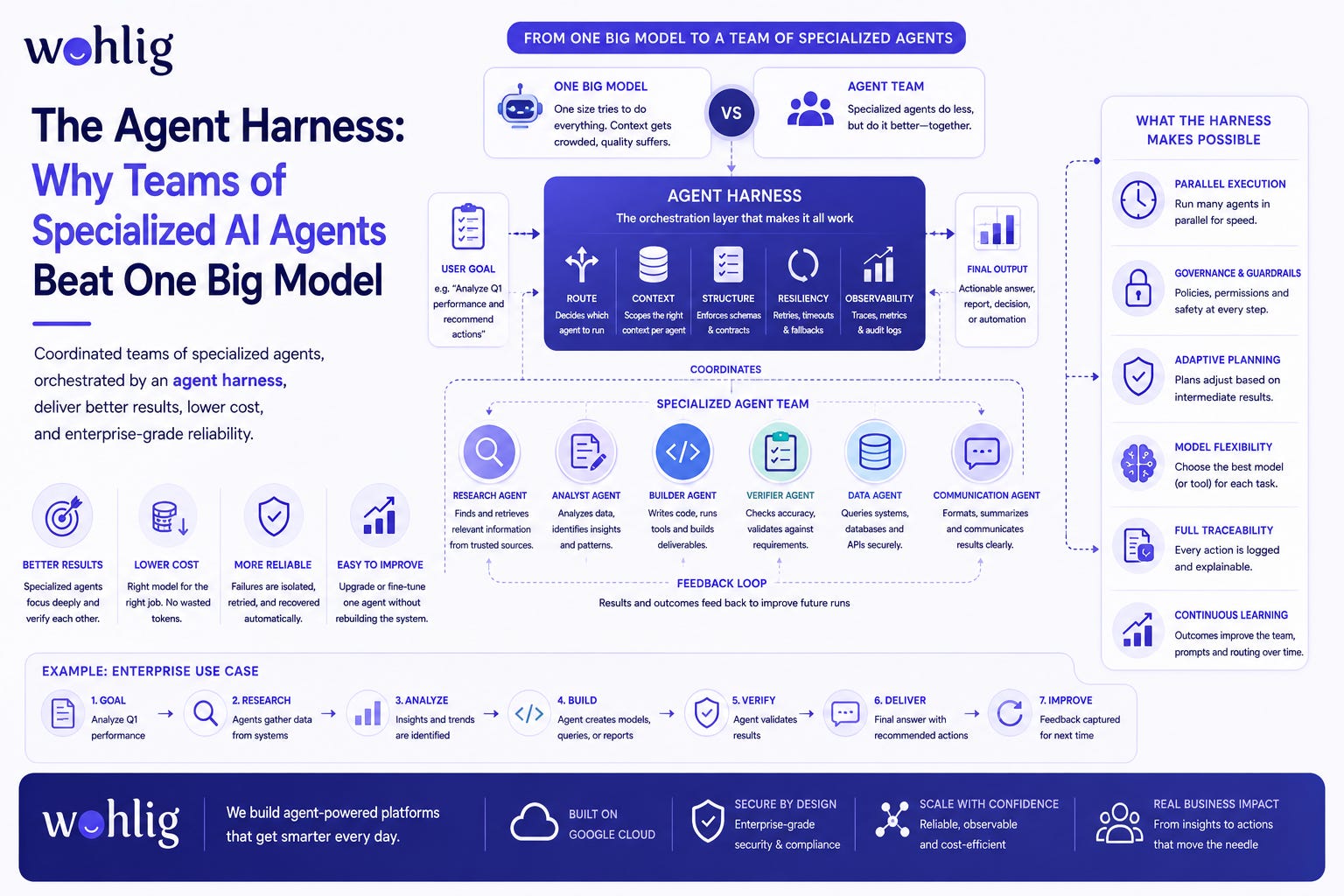
For a while, the answer to every hard AI problem was the same: use a bigger model with a longer context window and put everything into a single prompt. It’s an appealing idea, because it’s simple. In practice, it runs into ceilings that no amount of extra tokens fully removes — attention degrades, reasoning drifts, and failures are hard to isolate.
Multi-agent systems take a different approach. They split the work across specialised agents coordinated by an orchestration layer known as an agent harness. In 2026, that harness — rather than the model itself — is becoming the center of gravity in agentic AI, because it’s what turns a promising demo into a system you can actually operate, monitor and defend.
The limits of one big context window
Cramming an entire enterprise workflow into one model and one giant prompt hits three ceilings, and no amount of extra context fully removes them.
The first is attention. As you fill a context window with instructions, documents, tool outputs and prior conversation, the model’s ability to weigh the right details reliably tends to degrade. Important facts get buried, and the model can anchor on the wrong ones.
The second is role confusion. A single agent asked to plan, research, write code, check its own work and format the output is switching cognitive modes constantly, and quality suffers at the seams.
The third is observability. When one monolithic prompt produces a wrong answer, it’s genuinely hard to say which part of its reasoning failed — which makes the system difficult to debug and even harder to trust in production.
None of this means large models are the problem. It means a single model instance is the wrong unit of composition for a complex, multi-step business process. The better unit is a team.
What an agent harness actually is
An agent harness is the coordinating software that turns a collection of model calls into a working system. It’s the layer that decides which agent runs, what context each one receives, how their outputs are combined, and what happens when something fails. If a single agent is one worker, the harness is the operating model of the whole team: task assignment, hand-offs, quality control and escalation.
Concretely, a harness manages a few things a raw prompt cannot. It scopes context so each agent sees only what it needs, which keeps reasoning sharp and reduces cost. It enforces structure on inputs and outputs so agents can pass work to each other predictably. It handles retries, timeouts and fallbacks so a single flaky step doesn’t sink the run. And it produces a trace of what each agent did, which is what makes the system auditable. This coordination layer, rather than the model itself, is where much of the real engineering effort in agentic AI now sits.
Patterns that make multi-agent systems work
Multi-agent systems aren’t one architecture — they’re a small set of composable patterns. A few carry most of the weight in enterprise settings.
Orchestrator, workers and verifiers. An orchestrator agent breaks a goal into subtasks and delegates them to worker agents, each specialised for a narrow job such as retrieval, drafting, calculation, or calling a specific system. A separate verifier agent then checks the workers’ output against the original requirements. The key insight is that the agent producing work shouldn’t be the only agent judging it. Independent verification catches the confident mistakes that self-review misses.
Fan-out and synthesise. For research and analysis, the orchestrator fans a question out to several agents that work in parallel, each exploring a different source, angle or hypothesis. A synthesis agent then reconciles their findings into a single coherent answer, resolving contradictions and noting where evidence is thin. Because the parallel agents run at the same time, this pattern is often faster than a single agent working sequentially, and it covers more ground.
Scoped context per agent. Underlying both patterns is a discipline: give each agent a tight, purpose-built context rather than the whole history. A worker fetching a policy document doesn’t need the full conversation, and a verifier needs the requirements plus the output, not the messy reasoning in between. Scoped context is what lets a team of smaller, cheaper model calls outperform one enormous prompt.
These patterns compose. A production system might fan out to a set of workers, run each worker’s result past a verifier, and have an orchestrator decide whether to accept, retry, or escalate to a human. The harness is what holds that whole shape together.
Why teams beat one big model in production
The advantage of multi-agent systems isn’t that they’re clever — it’s that they’re governable. Specialised agents are easier to evaluate, because each one has a narrow job with a clear definition of done. Failures are easier to isolate, because a trace shows exactly which agent went wrong. Costs are easier to control, because you can route simple subtasks to smaller models and reserve the most capable model for the steps that truly need it. And behaviour is easier to improve incrementally, because you can upgrade one agent or one prompt without rewriting the entire system.
For enterprise leaders, this maps directly onto the things that actually block AI from reaching production: reliability, auditability and cost predictability. A single giant prompt optimises for a good demo. An orchestrated team optimises for a system you can operate, monitor and defend to a risk committee. That difference is why the center of gravity in agentic AI has shifted from picking the biggest model to designing the harness around it.
How Wohlig helps
Wohlig Transformations is a Google Cloud transformation and AI partner. We design and build orchestrated multi-agent systems on Google Cloud — from the orchestration and verification layer down to the data platforms, developer tooling and BI that agents depend on. That means we help you choose the right patterns for your workflows, wire agents to your real systems securely, and put the observability and guardrails in place that make agentic AI safe to run at scale.
If you’re moving from single-prompt experiments toward production multi-agent systems, we can help you get the harness right. Reach out to Wohlig to scope an agentic AI initiative on Google Cloud, and turn a promising demo into a system your teams can rely on.