

A Wohlig Transformations Whitepaper
Executive Summary
The modern marketing department runs on five to nine disconnected SaaS tools, an external performance agency, and a quarterly PDF audit that arrives weeks after it is useful. The result is structurally predictable: 20–40% paid-media waste, slow reporting, fragmented customer data, and a privacy posture that fails any serious regulator review.
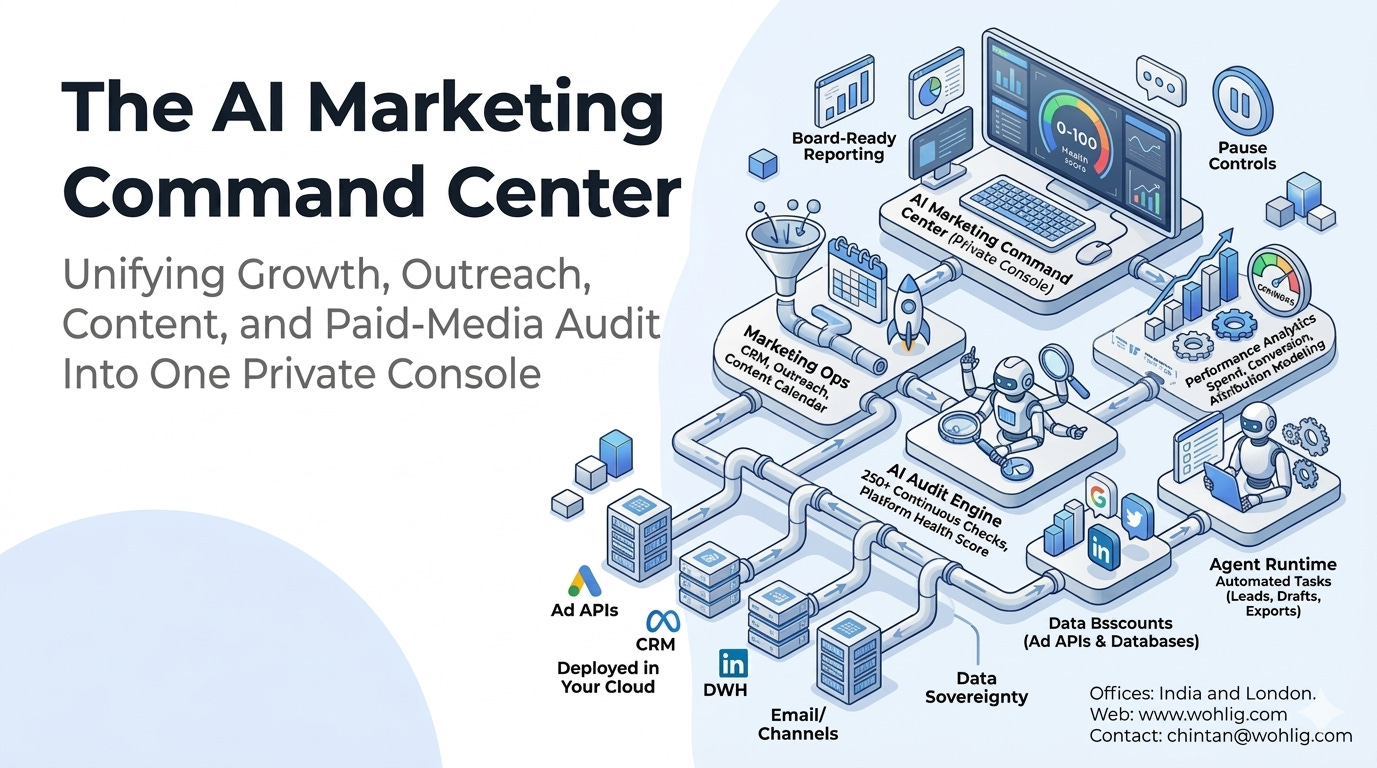
Wohlig’s AI Marketing Command Center is a private, deployed-in-your-cloud platform that consolidates CRM, lead pipeline, outreach, content calendar, performance analytics, and a continuous AI-driven paid-media audit engine into a single console. It replaces a stack of subscriptions with a single governed platform owned by the customer, deployable on-prem for regulated industries.
This paper outlines the problem, the architecture, the audit methodology, and the engagement model.
1. The Problem with Today’s Marketing Stack
Wohlig’s discovery work across mid-market and enterprise marketing teams has identified five recurring pain points:
Tool sprawl. A typical marketing operation runs CRM (Salesforce / HubSpot), an email sequencer, a content calendar tool, paid-media reporting (Supermetrics / Looker), an audit tool, and increasingly an “AI assistant.” None of them share data cleanly.
Stale audits. Paid-media audits are quarterly, manual, and produced by external agencies. Issues persist for weeks before being discovered.
Spend leakage. Misconfigured pixels, broken CAPI / Events API integrations, untracked landing pages, audience overlap, and dayparting misfires routinely waste 20–40% of paid budget.
Privacy and sovereignty exposure. Sending lead lists, conversion data, and CRM exports through third-party SaaS conflicts with internal privacy policies and emerging regulation (DPDPA, GDPR, sectoral rules).
No board-ready reporting. CMOs spend the last week of every quarter reconciling spreadsheets to produce a single performance view for the board.
2. The Solution: One Private, AI-Driven Console
The Command Center brings four capability layers into one deployment:
2.1 Marketing Operations Layer
CRM and lead pipeline management.
Multi-channel outreach orchestration with audit logs and pause controls.
Editorial and content calendar.
Cron-style scheduled marketing automations (lead refresh, scoring, outreach windows).
2.2 Performance Analytics Layer
Cross-platform spend, conversion, and revenue tracking.
Attribution windows and customer-journey views.
ROAS, CPA, LTV:CAC modeling at campaign and cohort granularity.
2.3 AI Audit Engine
250+ checks per platform across Google Ads, Meta, LinkedIn, TikTok, Microsoft Bing, Apple Search Ads, and YouTube.
Industry-tuned templates (SaaS, e-commerce, B2B, healthcare, finance).
0–100 health score and A–F grade per platform.
Prioritized fix list with estimated impact.
A/B test design recommendations.
Competitor creative intelligence.
Landing page conformance and Consent Mode V2 / CAPI / Events API validation.
Auto-generated client-ready PDF reports.
2.4 Agent Runtime
Internal agents handle routine ops: weekly export pulls, lead re-scoring, content draft generation, audit scheduling.
Each agent is specified, reviewed, and versioned (see Wohlig’s Governed AI Skill Factory whitepaper for the underlying methodology).
3. The Audit Methodology
The audit engine is the differentiator. It runs the following passes on each platform:
Tracking integrity — Pixel firing, CAPI / Events API health, server-side tagging, Consent Mode V2 compliance.
Account hygiene — Naming conventions, structure, negative keywords, audience overlaps, ad scheduling.
Creative quality — Ad-copy variants, image specs, CTR vs benchmarks, fatigue indicators.
Bid and budget — Bid strategy fit, budget pacing, dayparting, attribution window.
Landing experience — Page speed, mobile fitness, message match, form friction.
Financial model — CPA, ROAS, LTV:CAC modeling against industry benchmarks.
Competitor view — Public ad library scan, creative themes, frequency, positioning.
The output is normalized into a single 0–100 score per platform, a letter grade, and a prioritized list of actions sized by estimated business impact. Reports are generated as branded PDFs, dashboard widgets, and CRM-aware tasks.
4. Reference Architecture
                  ┌─────────────────────────────────────┐
                  │  AI Marketing Command Center (UI)   │
                  └──────────────┬──────────────────────┘
                                 │
          ┌──────────────────────┼──────────────────────┐
          │                      │                      │
   ┌──────▼──────┐       ┌───────▼──────┐       ┌──────▼─────-─┐
   │   CRM /     │       │  Performance │       │   Audit      │
   │   Pipeline  │       │  Analytics   │       │   Engine     │
   └─────────────┘       └──────┬───────┘       └──────┬───────┘
                                │                      │
                          ┌─────▼──────────────────────▼─────┐
                          │      Agent Runtime + Scheduler   │
                          └─────┬────────────────────────────┘
                                │
                       ┌────────┼────────┐
                       │        │        │
              ┌────────▼┐ ┌─────▼──┐ ┌──▼─────────┐
              │ Ad APIs │ │ CRM /  │ │ Email /    │
              │ (Live)  │ │ DWH    │ │ Channel    │
              └─────────┘ └────────┘ └────────────┘
Deployed inside the customer’s chosen cloud (GCP, AWS) or on-prem. Identity through customer SSO. Secrets in customer secret manager. Telemetry into customer observability stack. Data does not leave the customer’s environment.
5. Outcomes Wohlig Customers Can Expect
Recover 15–30% of paid budget within the first two quarters by acting on continuous audit findings.
Compress reporting cycles from quarterly to weekly without additional headcount.
Replace 4–6 SaaS subscriptions with one platform — typically ROI-positive within 6–9 months on subscription savings alone.
Pass internal privacy review because all data remains inside the customer’s tenancy.
Give the CMO a board-ready scorecard generated automatically.
6. Engagement Model
Phase A — Discovery (2 weeks). Audit existing stack and spend profile. Identify the highest-leakage platforms and the highest-priority data integrations.
Phase B — Deploy (4–6 weeks). Stand up the command center in the customer’s cloud. Connect ad platforms, CRM, and email. Configure industry-specific audit templates.
Phase C — Optimize (ongoing). Run weekly audits, act on findings, expand to additional channels and brands. Wohlig stays as much or as little as the customer wants.
7. About Wohlig
Wohlig Transformations is a digital transformation, cloud, and AI consulting firm founded in 2016. We have shipped 10+ generative-AI solutions in production, completed 20+ cloud migrations, and hold 40+ Google Cloud certifications. We serve governments (Maharashtra, Gujarat, ONDC), enterprises (Lodha, Eros Now, Hungama), and high-growth consumer companies (Swiggy, Ninjacart, PW Live).
Offices: India and London. Web: www.wohlig.com.
To discuss your marketing transformation roadmap, reach Wohlig at chintan@wohlig.com.