

A Wohlig Transformations Whitepaper
Executive Summary
Generative AI has reduced the cost of drafting documents by an order of magnitude. The cost of finishing them — making them look on-brand, consistent, and client-ready — has not moved. The result is a new kind of design debt: faster drafts, but inconsistent output, and human cleanup time that erodes the productivity gain.
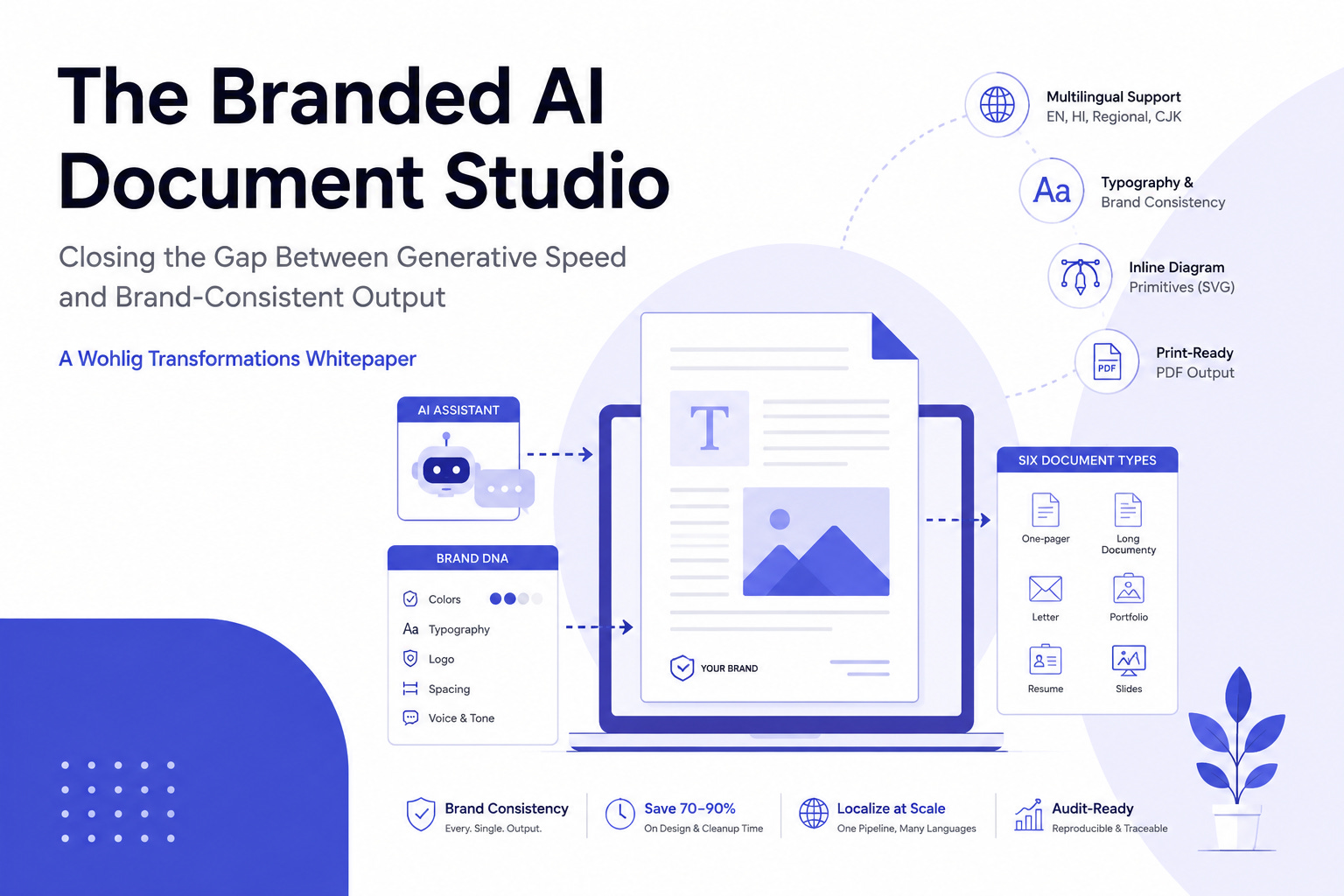
Wohlig’s Branded AI Document Studio is a deployed-into-your-cloud capability that wraps any AI assistant in a single brand-enforcing constraint layer. Every output is rendered through six standardized document types — one-pager, long document, letter, portfolio, resume, and slides — with palette, typography, logo, spacing, multilingual support, and inline diagram primitives baked in.
This paper covers the problem, the architecture, the integration model with existing AI tools, the brand-DNA configuration, and the engagement plan.
1. The Problem
AI output style drift — Same firm, ten teammates, ten different document looks.
Cleanup tax — 30–60 minutes of human design polish per AI-drafted document.
Brand audit failures — Logos misused, palettes inconsistent, type misapplied.
Localization gap — English-only AI outputs, manual rework for Hindi / regional / CJK.
Knowledge-ops irreproducibility — “What did we send the client in Q2?” has no clean answer.
2. Solution Pattern
A small, deterministic constraint layer that:
Lives inside the AI assistant the team already uses.
Enforces a single brand specification on every output.
Renders the output as a print-ready PDF with no human design step.
Supports multiple document archetypes with shared brand DNA.
Is owned by the customer, fork-able, and brand-version-controlled.
3. Architecture
┌────────────────────────────────────────────────────┐
│            AI Assistant (existing)                 │
│   (the model your team already uses for drafting)  │
└──────────────────────┬─────────────────────────────┘
                       │  prompt → markdown
                       ▼
┌────────────────────────────────────────────────────┐
│         Branded AI Document Studio (Wohlig)        │
│                                                    │
│   Brand DNA config ──┐                             │
│   ┌──────────────────┴──────────────┐              │
│   │  Six template types             │              │
│   │  · One-pager  · Long doc        │              │
│   │  · Letter     · Portfolio       │              │
│   │  · Resume     · Slides          │              │
│   └────────────────┬────────────────┘              │
│                    ▼                               │
│   Inline SVG diagram primitives                    │
│                    ▼                               │
│   Multilingual font set (EN, HI, regional, CJK)    │
│                    ▼                               │
│   HTML/CSS-to-PDF renderer                         │
└──────────────────────┬─────────────────────────────┘
                       │
                       ▼
              Brand-consistent PDF
The studio is deployed into the customer’s environment — laptop, internal tool, or private cloud, depending on use case — and is fork-able and entirely customer-owned.
4. The Brand DNA Configuration
A single file captures the firm’s visual and editorial identity:
Palette — primary, secondary, accent, and semantic colors.
Typography — body, heading, and accent typefaces, with size and weight scales.
Logo usage — placement rules, clear-space, light/dark variants.
Spacing & layout — page margins, paragraph rhythm, table styles.
Voice — short editorial guidelines (tone words, do/don’t list).
Disclaimers & footers — boilerplate that must appear on regulated document types.
Languages — which scripts to support and which fonts apply per language.
This single configuration is the source of truth. Updating brand guidelines is a one-line change that propagates to every future output.
5. Document Archetypes Covered
One-pager — Product brief, exec summary, capability sheet
Long document — Proposal, whitepaper, policy memo, RFP response
Letter — Formal correspondence, offer letter, legal letter
Portfolio — Case studies, project showcases, work samples
Resume — Candidate dossier, internal HR profile
Slides — Short, accompanying decks for memos
Custom archetypes (board reports, regulatory filings, audit memos) can be added without breaking the brand layer.
6. Outcomes
Time-per-document polish reduction — 70–90%
Brand-consistency rate of AI-assisted documents — from <50% to >95%
Localization throughput — step change — same pipeline produces EN, HI, regional, CJK
Sales-asset personalization volume — 5–10x more per-account assets
Audit-ready document reproducibility — yes (every output traceable to template + brand version)
7. Where It Fits
Consulting, advisory, and professional services — proposal and memo factories.
Investment, legal, and accounting boutiques — branded letters and one-pagers at volume.
HR-tech and recruiting — candidate dossiers per role.
In-house enterprise marketing/brand teams — governance over AI-assisted document drafting.
B2B SaaS sales orgs — per-account proposal generation.
8. Engagement Model
Phase A — Brand DNA capture (1–2 weeks). Extract the firm’s visual, editorial, and regulatory identity into a single configuration file.
Phase B — Studio deployment (2–4 weeks). Stand up the six document templates. Integrate inline diagrams, multilingual support. Wire the studio into the team’s existing AI assistant.
Phase C — Roll out and iterate (ongoing). Train champions in each department. Add custom archetypes. Refine brand DNA as feedback arrives. Wohlig stays as advisor or operator depending on customer preference.
9. About Wohlig
Wohlig Transformations is a digital transformation, cloud, and AI consulting firm founded in 2016. We have shipped 10+ generative-AI solutions in production, completed 20+ cloud migrations, and hold 40+ Google Cloud certifications. We serve governments (Maharashtra, Gujarat, ONDC), enterprises (Lodha, Eros Now, Hungama), and high-growth consumer companies (Swiggy, Ninjacart, PW Live).
Offices: India and London. Web: www.wohlig.com.
To discuss your branded document automation, reach Wohlig at chintan@wohlig.com.