

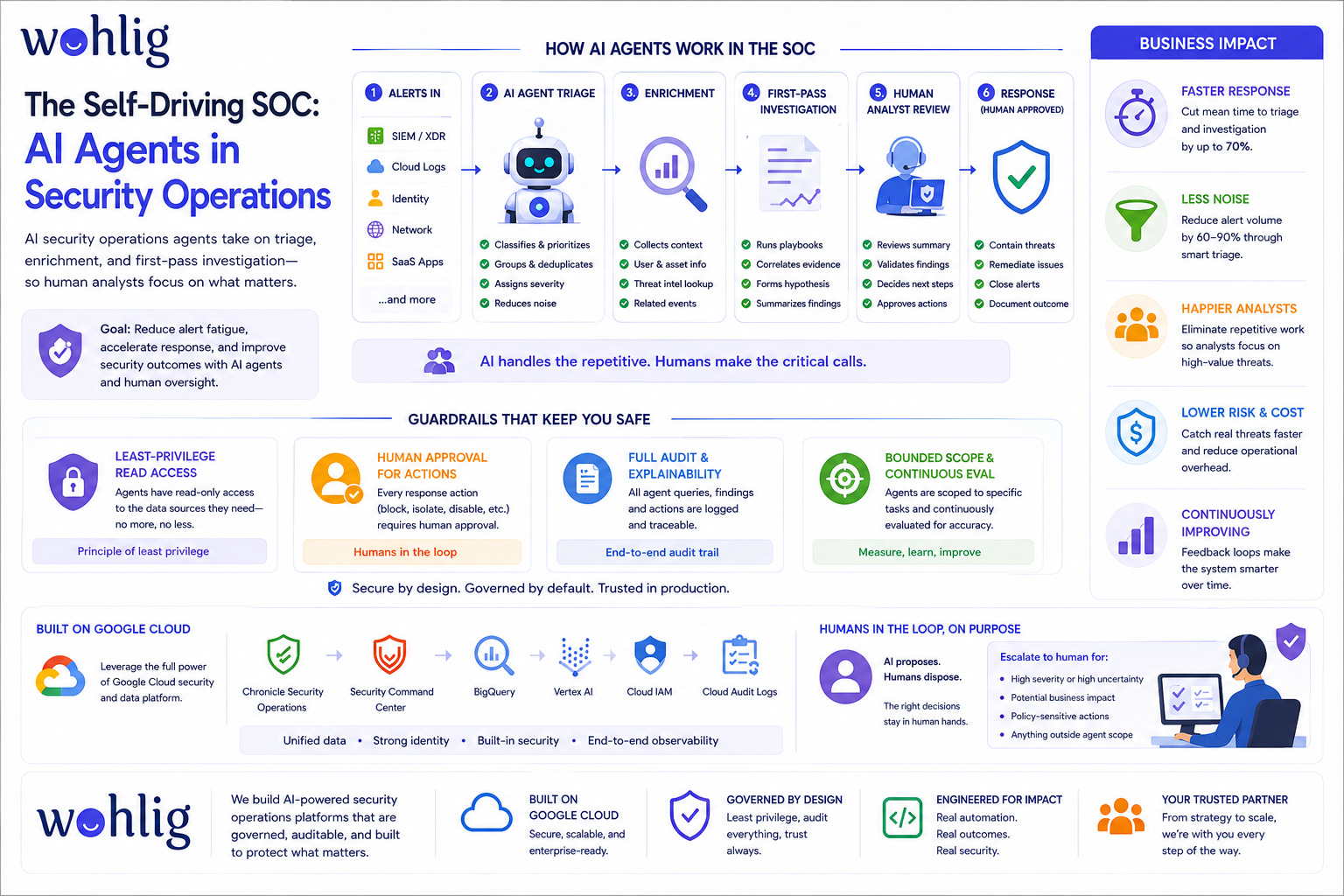
Ask any security operations leader what keeps their team up at night and, before they mention nation-state actors, they’ll mention volume. A modern enterprise security operations center (SOC) ingests signals from cloud workloads, endpoints, identity providers, network telemetry and dozens of SaaS tools. The result is a firehose of alerts, most of which are benign, duplicated or low priority.
In 2026, AI agents are starting to absorb the most repetitive part of that work — alert triage, enrichment and first-pass investigation — so human analysts can focus on the judgement calls that matter. But the model only works with strict guardrails: least-privilege read access, human approval for any response action, and a full audit trail.
The alert fatigue problem is a people problem
Alert fatigue is the predictable outcome of that firehose. When analysts triage hundreds of alerts a shift, attention degrades, real threats get buried in the noise, and the genuinely dangerous signal is more likely to be closed as routine. The cost isn’t only missed detections. It’s also burnout, high turnover in a role that’s already hard to hire for, and slower response when speed matters most.
The traditional answer was more tooling and more headcount. Neither scales cleanly. Tuning rules reduces some noise but introduces blind spots. Adding people is expensive and slow, and it still leaves skilled analysts doing work that’s beneath their expertise. This is the gap that AI security operations is built to close.
What AI agents actually do in the SOC
The useful framing isn’t that agents replace analysts. It’s that agents take the first, most repetitive pass so analysts start their work already informed. In practice, that breaks into three jobs.
Triage. When an alert fires, an agent can classify it against context the analyst would otherwise gather by hand. Is this asset internet-facing? Is the identity involved privileged? Has this pattern fired a hundred times this week and always resolved as benign? The agent groups related alerts, deduplicates, and assigns a preliminary severity so the queue arrives sorted rather than raw.
Enrichment. A raw alert is rarely enough to make a decision. An agent can pull the surrounding context automatically: recent activity for the user or service account, the reputation of an external IP, the configuration of the affected resource, and related events across other tools. What used to be twenty minutes of tab-switching becomes a structured summary attached to the alert.
First-pass investigation. For well-understood alert types, an agent can follow the same investigative playbook a junior analyst would — querying logs, correlating timelines, and forming a hypothesis about whether the activity is malicious. It then hands the analyst a narrative: here’s what happened, here’s the evidence, here’s what I think, and here’s what I’m not sure about.
The through line is that the agent does the reading, gathering and drafting. The human does the deciding.
Guardrails are not optional
An AI agent with broad access to security systems is itself a serious risk. The value of AI security operations depends entirely on the guardrails around it. Four are mandatory.
Least-privilege, read-only by default. Investigation requires reading logs and telemetry, not changing them. Agents should operate with narrowly scoped, governed read access to exactly the data sources their task needs, and nothing more. Access is granted per use case, reviewed, and revocable.
Human approval for every response action. Reading is one thing. Acting is another. Isolating a host, disabling an account, or blocking an address can disrupt the business as much as an attacker can. Any response action must be proposed by the agent and approved by a human. The agent recommends, the analyst authorises, and that boundary is enforced by design, not by policy alone.
Full audit and explainability. Every query an agent runs, every conclusion it reaches, and every action a human approves must be logged in a tamper-resistant record. When a decision is questioned later — whether in an incident review or a compliance audit — the team needs to reconstruct exactly what the agent saw and why it acted. An agent that can’t show its work doesn’t belong in the SOC.
Bounded scope and continuous evaluation. Agents should be scoped to specific, well-defined tasks with clear success criteria, and their performance should be measured over time. False negatives and overconfident conclusions are tracked and corrected, and humans retain oversight of where and how agents are deployed.
Treat these as the price of admission. An agent that triages fast but can’t be governed is a liability, not an asset.
Keeping humans in the loop, on purpose
“Human in the loop” is easy to say and easy to hollow out. If analysts rubber-stamp every agent recommendation because the queue is still overwhelming, the guardrail is theatre. The design goal is to raise the quality of human attention, not just its speed.
That means agents should surface uncertainty honestly, flag the cases they’re least confident about, and escalate anything ambiguous rather than forcing a verdict. It means the most consequential decisions — confirming a breach, taking a production system offline, notifying stakeholders — always sit with a person who has the context and the authority. The agent compresses the routine so the human has room for the exceptional.
How Wohlig helps
Wohlig Transformations is a Google Cloud transformation and AI partner, and we build security operations automation the same way we build the rest of our agentic AI work: governed, auditable and human-directed.
On Google Cloud, we help enterprises bring together posture management, threat detection and vulnerability scanning, then layer agentic workflows on top for triage, enrichment and first-pass investigation. We design least-privilege access models so agents read only what they need, wire in mandatory human approval for response actions, and make the full audit trail a first-class part of the system rather than an afterthought. The outcome is a SOC where analysts spend their time on the calls that require judgement, and the repetitive work runs itself under a watchful eye.
If you’re a CISO or security leader looking to reduce alert fatigue without giving up control, talk to Wohlig about building AI security operations on Google Cloud, with humans firmly in the loop.