

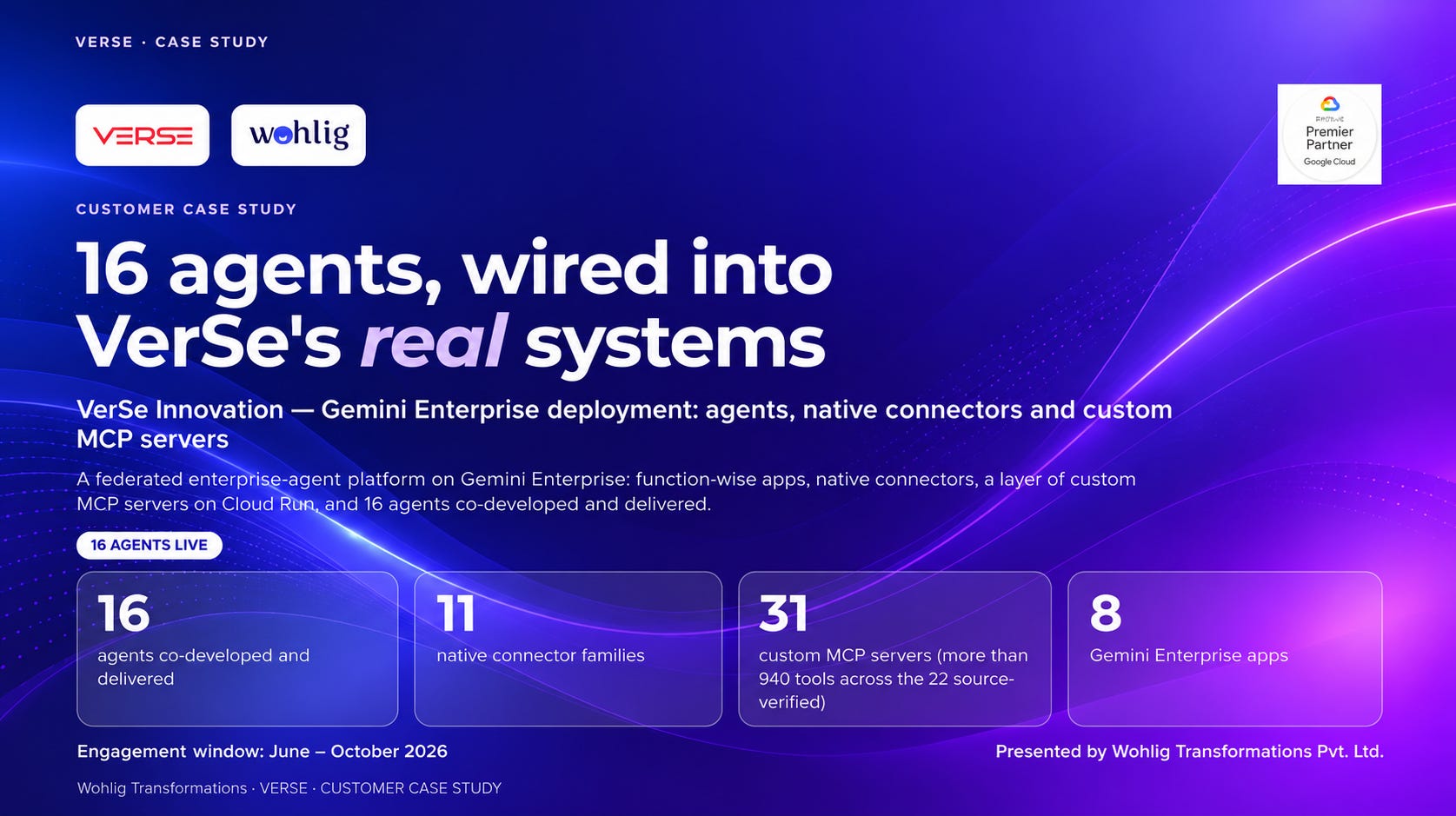
VerSe, the group behind Dailyhunt and Josh, partnered with Wohlig Transformations to turn Gemini Enterprise from a search-and-chat tool into a working layer over its own systems. Between June and October 2026 the two teams co-developed and delivered 16 agents, configured 11 native connector families, and built or deployed 31 custom MCP servers on Cloud Run, with more than 940 tools across the 22 servers whose source was verified. The agents are live across travel, HR, finance, IT, security and legal work.
Project Overview
VerSe bought Gemini Enterprise and set up its first apps itself. The harder work was making agents useful on real systems: a travel desk with ten spend streams, an HR system holding every employee’s record, a cloud-cost warehouse, an IT estate spread over Jira, GitLab, Jenkins, Grafana and Prometheus. Many of these tools have no native connector.
Wohlig worked alongside VerSe’s teams to build the missing layer. It has four parts: 8 function-wise Gemini Enterprise apps, 11 native connectors, 31 custom MCP servers that give agents safe access to everything else, and the 16 agents on top. Wohlig also delivered the Gemini Enterprise integration layer inside VerSe’s own desktop IT assistant. VerSe’s developers and contractor team built that assistant’s interface; Wohlig built the layer that connects it to Gemini Enterprise, including approval cards, a connector authorisation gate and region handling.
The Challenge
A tool estate with no native connector. About thirty tools that VerSe’s teams rely on, including GitLab, Jenkins, Prometheus, Grafana, ClickHouse, SAP SuccessFactors and MakeMyTrip, had none. Without a connector, an agent cannot read or change anything in them.
Identity and access sprawl. Two Workspace domains, a Microsoft Entra population and per-user sign-in for every action meant that nobody had one view of who could open which app.
Federated answers are slow by design. Most connectors make live calls, so one question fans out across mail, Drive, Chat, Jira, MCP servers and search. On the global endpoint that meant 20 to 60 seconds per answer (reported by the project team).
Agents inside VerSe’s own desktop assistant, with human approval. VerSe wanted agents in its own application, with an approve-or-reject step before anything changes. The public interfaces at the time did not carry agent targeting, action approval or file upload in the way the assistant needed.
Key Objectives
Connect the estate: Native connectors where they exist, custom MCP servers where they do not.
Safe by construction: Read-only first, writes behind flags and confirmation cards, destructive actions off by default.
Agents that do real work: Travel, HR, FinOps, IT, SRE, legal and security agents on live systems.
Inside VerSe’s own assistant: Agents and approval cards working in the desktop IT assistant.
Fast enough to use: Cut federated-answer latency with a US-endpoint estate and design changes.
Handed over: Source, runbooks and restore packages that VerSe’s engineers can own.
The Solution: A Federated Enterprise-Agent Platform on Gemini Enterprise
Eight apps, two regions. One Gemini Enterprise app per function (General, IT and infrastructure, HR, FinOps, Legal, Sales, Admin, plus one reserved), each mirrored on a US-endpoint estate built in September.
11 native connector families. Gmail, Google Calendar, Google Drive, Google Chat, Google Groups, Jira Cloud, Confluence, GitHub, Zoho CRM, Microsoft Entra ID and Dynamics 365. A further 8 Google-managed MCP data stores (Logging, Monitoring, Compute, GKE, Resource Manager, Billing, Cloud CLI, Maps) are registered but are not counted as connectors.
31 custom MCP servers on Cloud Run. 22 have verified source, exposing 946 tools in the handover export (more than 940); 9 were deployed from images, so their tool counts are not verified. By domain: business systems and data (MakeMyTrip travel, SAP SuccessFactors, ClickHouse, Azure billing and others); work tracking, source and CI/CD (Jira x3, GitLab x2, Bitbucket, Jenkins, ArgoCD, Terraform); observability, cloud and edge (Prometheus, Grafana, GKE, gcloud, Akamai x2, Cloudflare, GoDaddy); security and admin (iSecure, ManageEngine, SentinelOne, password, LDAP, Active Directory, Vault, VM logs).
16 agents, all live. Productivity: Morning Briefing, Document Critique. Finance and FinOps: FinOps Dashboard. IT and SRE: SRE, IT Helpdesk, Incident Triage, Jira anomaly detection. Travel: Travel Desk, Travel Desk MIS Report Publish. HR and People: HR, Onboarding and offboarding. Legal and Security: Contract analysis, iSecure Admin, InfoSec Policy Advisor. Operations: Vault Email Backup, VM Logs. They are Gemini Enterprise agents, conversational or scheduled workflow, backed by the connectors and servers above.
18 other integrations and built assets. The desktop-assistant layers, two access portals, vanity domains, the onboarding and offboarding automation, an alert-triage pipeline, the travel build pipeline and anomaly engine, a gateway VM, an HR identity map, a 13-step integration guide, and runbooks with restore packages.
Key Benefits & Results
Previous: Agents could search and chat but could not act on VerSe’s systems. Our Solution: 11 native connectors and 31 custom MCP servers. Result: More than 940 tools verified from source across 22 servers, with 16 agents using them.
Previous: Federated answers took 20 to 60 seconds. Our Solution: A US-endpoint estate plus routing rules, trimmed search payloads and fewer connectors per query. Result: IT Helpdesk response time of roughly 5 to 12 seconds (reported by the project team).
Previous: No supported way to approve an agent’s action inside VerSe’s own assistant. Our Solution: Approval cards that execute through the connector path. Result: In a 23 September live test, 16 of 16 write-backs produced no re-proposal and 4 of 4 failure hand-backs produced a corrected card (reported by the project team).
Previous: A monthly travel report rebuilt by hand from ten spend streams. Our Solution: A build that reconciles every summary cell before publishing. Result: 1,584 summary cells and 1,848 per-head cells reconciled in the August build; an 18-case end-to-end regression passed 18 of 18 (reported by the project team).
Previous: HR questions waited for HR staff. Our Solution: An HR agent on VerSe’s production SAP SuccessFactors with identity-scoped access. Result: Each employee reaches only their own data; live since 24 September.
Not yet measured: Time saved, tickets deflected and weekly use. These are proposed measures for the next phase.
Technical Innovation
Approval Cards That Close the Loop. When the platform offered no public call to approve a custom-MCP action, Wohlig built the approval in the desktop assistant. The assistant shows a card, runs the approved action through the connector path as that user, writes the outcome back to the agent, blocks duplicates and hands failures back up to three times. It also stops the model from claiming a tool ran when it did not.
Reconcile or Refuse. The travel build recounts every summary cell independently and stops, leaving the last published report untouched, if any figure differs. The agent never computes a number; every figure comes from a tool, and live and published figures are never mixed.
Access Control Where the Source System Has None. The HR server takes the employee’s identity from the verified Google sign-in, accepts no employee identifier, builds every filter in one place, fails closed and writes as the employee, so SAP’s own approval routing applies.
Read-Only-First MCP Design. Read tools are always on, write tools sit behind per-server flags, destructive operations are off by default, and each server stays within the platform’s action limit. A shared admission gate validates the user’s token on every call.
A Connector Gate and a US Estate. A pre-chat check tells a user which connector grants are missing and links to the right panel. A parallel US-endpoint estate, built from browser-trace evidence, cut response times.
Verification, Not Just Demonstration. Deterministic harnesses against independent ground truth, regression suites and a live approval matrix back the build. Tests counted from code include 26 for the ClickHouse server, 48 for Grafana and 30 for GitLab.
Wohlig’s Approach
Discover and plan — A requirements walk-through, 15 requirements and a three-group connector plan.
Platform first — Function-wise apps, native connectors, the custom MCP pattern and the access model.
Build agents with the owners — The travel, HR, IT, FinOps and SRE teams tested each agent as it was built.
Prove the hard parts — Approval cards, the connector gate, the US endpoint and reconcile-or-refuse, each tested live.
Hand over — MCP source for 22 servers, the portals, deploy scripts, runbooks and restore packages, delivered on 29 September.
Iterate — Rework rounds with the travel, HR and IT teams through October.
About VerSe
VerSe Innovation Private Limited is an Indian local-language content and short-video group, headquartered in Bengaluru and best known for Dailyhunt, its local-language news and content platform, and Josh, its short-video app. It also runs an advertising business and regional news properties.
About Wohlig Transformations Pvt. Ltd.
Founded in 2016, Wohlig Transformations is a Google Cloud Premier Partner and a CNCF certified partner with 40+ Google Cloud certifications. With offices in Mumbai (HQ), Toronto, London, Bangalore and Delhi, Wohlig specialises in GenAI, Cloud Migration and DevOps.
Detailed Case Study Presentation: