

Wohlig Transformations · AI Engineering
There is a quiet failure mode in enterprise AI that nobody puts on
the slide deck. You build an agent. It works. It saves time. The
team is delighted. You build five more. Three months later, half of
them are silently broken — an upstream API changed a field, a tool
schema drifted, an edge case nobody anticipated has crept into
production. The team is back to doing the work manually. Token
spend is up. Confidence in AI is down. The CFO is asking pointed
questions.
This is the agent decay problem, and it is the single biggest
reason enterprise AI initiatives lose momentum after the first wave
of wins.
The other reason — even more expensive — is token-bill creep.
Every agent invocation re-derives the same reasoning the agent did
yesterday. The model thinks through the tax filing logic from
scratch. Then thinks through the compliance check from scratch. Then
thinks through the contract clause from scratch. Multiply by ten
thousand invocations a month, and you are paying for the same
thinking, repeatedly, in perpetuity.
Wohlig builds the fix. We call it a Self-Improving Agent
Platform.
The pattern
Three properties make agents compound rather than decay:
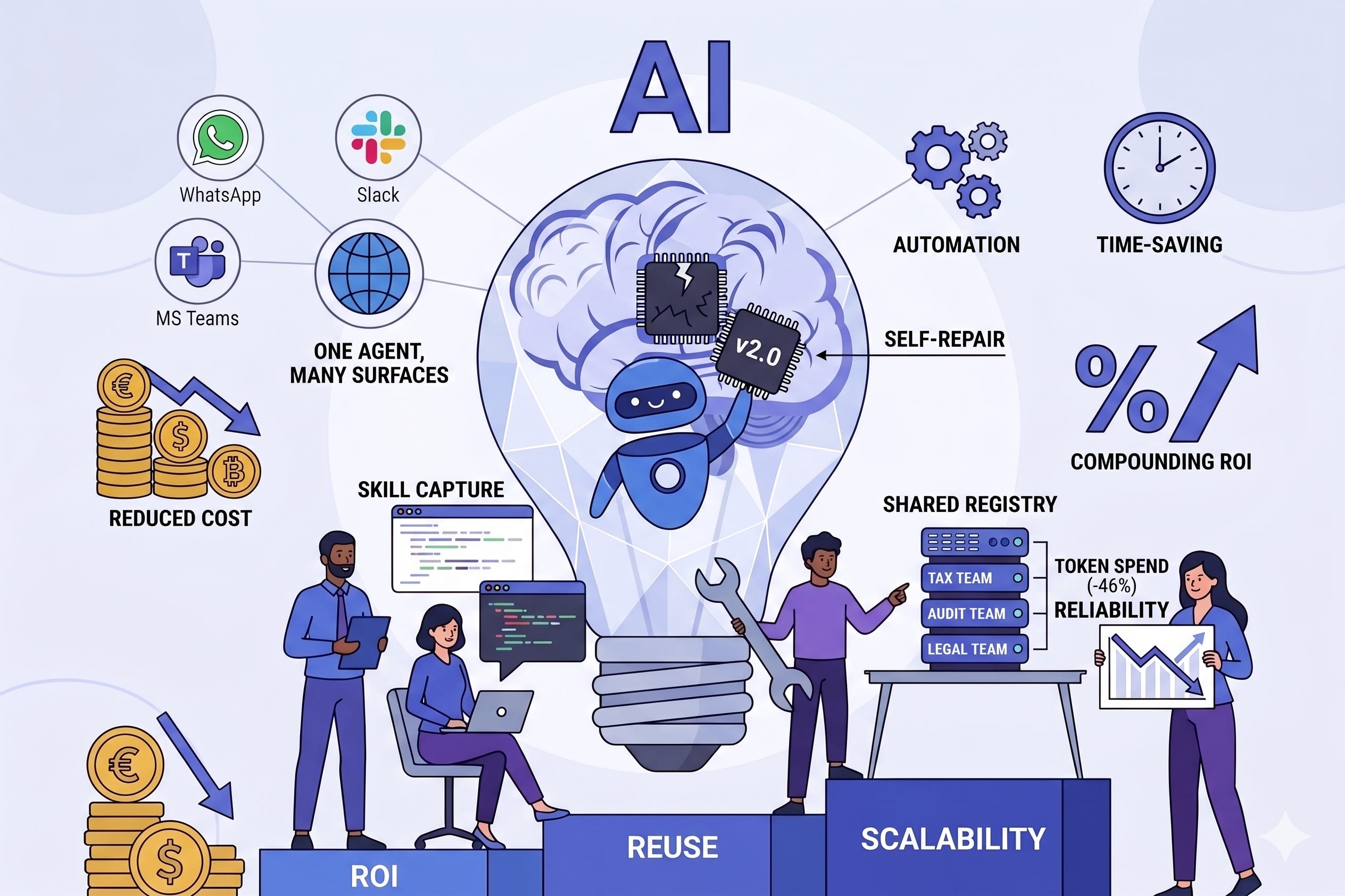
1. Skill capture. When an agent successfully completes a task,
the workflow is captured as a named, versioned, reusable skill.
The next time a similar task arrives, the agent does not re-reason
from scratch — it retrieves the skill and runs it. This alone cuts
token spend by 30–50%, with the savings compounding as the skill
library grows.
2. Self-repair. Skills are monitored continuously. When a skill
fails — because a tool changed, a schema drifted, or an edge case
appeared — the platform diagnoses the failure and patches the skill
automatically. No engineer chasing the regression. No quiet decay.
The agent is back online while the team is still at lunch.
3. Shared registry. Skills are stored in a governed registry
that every agent in the organization can read from. When the tax
team’s agent learns to handle a new GST schema, the audit team’s
agent and the legal team’s agent benefit immediately. One team’s
work compounds into capability for everyone else.
The result is what AI was always supposed to deliver: capability
that grows with use, instead of decaying.
What changes for the business
Token spend collapses. Industry data on this pattern shows
roughly 46% reduction in token usage. For an enterprise running
serious agent workloads, that is real money — and the savings grow
with adoption rather than shrinking.
Reliability stops being a fire drill. Agents that used to
silently break and trigger emergency engineering investigations now
self-heal. The engineering team focuses on building new capability
rather than maintaining last year’s.
Knowledge stops being trapped. The clever agent the marketing
team built that nobody else knows about now lives in the registry,
discoverable, reusable, and auditable. Capability accumulates across
the organization.
ROI becomes measurable. Every skill carries execution history,
version lineage, and cost-per-run metrics. When the CFO asks “what
did we save with AI this quarter?” — the answer is a real number
with a permalink.
One agent, many surfaces. A skill written once works whether
the agent is invoked from WhatsApp, Slack, Microsoft Teams, an
internal portal, a CLI, or a desktop integration. The platform
abstracts away the surface — your customers and employees use it
where they already are.
Where this works
This is not for a team running their first AI pilot. This is for
organizations that have already shipped multiple AI workflows and
are now staring at:
A token bill that has climbed every month for six months.
A backlog of “agent X is broken again” tickets.
A growing realization that the same capability is being rebuilt
three times in three departments.
If that sounds familiar — particularly in BFSI, professional
services, BPO/KPO, or document-heavy enterprises — the
self-improving pattern is the next architectural step.
Where Wohlig fits
We do four things:
Build the platform. The skill engine, the registry, the
self-repair loop, the multi-surface gateway, the dashboard.
Deployed inside your cloud, governed by your identity, audited
by you.Migrate your existing agents. Whatever you have built so far
— copilots, chatbots, automation scripts — gets wrapped as
skills, versioned, and brought into the registry.Train your AI team. Engineers and domain experts get the
patterns and the playbooks for authoring durable skills.Operate it with you. As much or as little as you want —
managed service, hybrid, or pure advisor.
The honest summary
The first wave of enterprise AI was about getting agents into
production. The second wave — the one that actually delivers ROI —
is about making those agents compound rather than decay. Skill
reuse cuts cost. Self-repair preserves reliability. A shared
registry turns one team’s wins into the whole organization’s
capability.
Wohlig builds this. If your AI program is at the stage where the
costs are obvious and the returns are getting harder to point to,
this is what comes next.
Wohlig Transformations builds AI, cloud, and data platforms for
governments, enterprises, and high-growth startups. 10+ generative-AI
solutions in production. Founded 2016. Offices in India and London.